
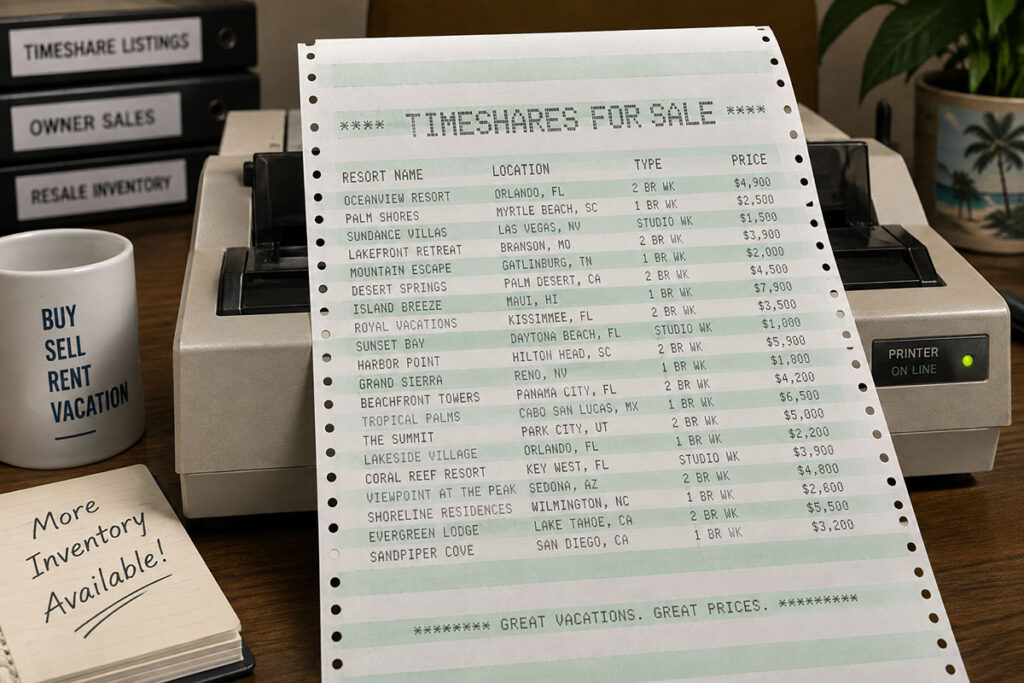
Understanding the Timeshare Resale Market: What Every Owner Should Know
Many timeshare owners eventually reach the same point: the ownership no longer fits their life, and they begin looking for a way to sell it.
That search can be frustrating because the timeshare resale market operates very differently from the market in which the timeshare was originally purchased. An owner may have paid tens of thousands of dollars during a developer sales presentation, only to discover years later that comparable ownership interests are being advertised on the secondary market for considerably less.
For some owners, a legitimate resale may still be possible. For others, there may be little buyer demand, transfer restrictions, outstanding financing, or annual fees that make a sale difficult. Unfortunately, owners searching for a buyer may also encounter companies or individuals making promises that deserve careful scrutiny.
Before listing a timeshare, paying a resale company, or assuming the ownership has no value, it helps to understand what is being sold, what similar interests are selling for, and what obligations will transfer with the ownership.
The Timeshare Resale Market Is Different from the Developer Market
A new timeshare is generally purchased from a developer during a sales presentation. The purchase price can reflect much more than the underlying vacation interest. Marketing expenses, sales commissions, financing, incentives, resort amenities, and the overall sales operation can all be part of the primary-market transaction.
The resale market is different.
Instead of buying directly from the developer, a resale purchaser acquires an existing owner’s interest. Depending on the program, that could involve a deeded week, a points-based ownership, a beneficial interest in a trust, a club membership, or another form of vacation ownership.
There is also no single national resale price for a timeshare. Two interests connected to the same resort may have different values because of season, location, points allocation, reservation rights, annual fees, usage restrictions, or benefits that may not transfer to a resale buyer.
This is one reason owners should be cautious about assuming the original purchase price represents the current resale value. What an owner paid and what another consumer is willing to pay today can be two very different numbers.
Why Some Timeshares Can Be Difficult to Resell
Timeshares should generally be viewed as vacation-use products rather than traditional financial investments. A conventional home has a broad potential market because the buyer can live in it, rent it, renovate it, or potentially resell it as market conditions change. A timeshare is much more specialized. The buyer is purchasing a particular type of vacation access along with the rules and ongoing financial obligations attached to it.
That can significantly reduce the pool of potential buyers.
Maintenance fees are another consideration. A buyer evaluating a resale is not simply deciding whether the purchase price is attractive. The buyer also needs to understand the annual maintenance fees, possible assessments, reservation system, exchange rights, and other continuing costs associated with ownership.
Developer benefits can complicate the analysis further. Some programs provide incentives or benefits to consumers who purchase directly from the developer that may not transfer to a resale purchaser. The importance of those restrictions depends on the particular program, but they can influence what buyers are willing to pay on the secondary market.
Outstanding financing presents another potential obstacle. Selling the timeshare does not automatically eliminate a loan used to purchase it. Owners should understand how any remaining financing affects their ability to transfer the interest before entering into a resale agreement.
For these reasons, some owners may find that the secondary-market value is substantially below the amount originally paid. Others may discover that finding a willing buyer is more important than recovering the original purchase price.
Start by Determining What You Actually Own
Before asking, “What is my timeshare worth?” an owner should first answer a more basic question: What exactly am I trying to sell?
That is not always as obvious as it sounds.
A traditional deeded week may represent an interest in a particular property. A points program can involve a very different legal structure. Other owners may have trust interests, club memberships, right-to-use arrangements, or ownerships that have been upgraded or converted several times.
The documents should explain the ownership and the rules governing its transfer. Owners should look at the deed or membership documents, purchase agreement, points or club materials, financing documents, maintenance-fee statements, and any subsequent upgrade agreements. Transfer restrictions and developer resale policies also deserve attention.
This document review can prevent an owner from spending money marketing an interest that cannot be transferred in the manner being proposed. It can also help establish what should be compared when researching resale prices.
An advertised price for a vaguely similar timeshare is not necessarily a meaningful comparison. The more useful question is what comparable ownership interests have actually sold for, if reliable transaction information is available.
Be Careful When Someone Says They Already Have a Buyer
Timeshare owners should be particularly cautious when an unexpected caller claims to already have someone interested in purchasing their ownership. That does not mean every unsolicited resale offer is fraudulent. It does mean the claim should be independently verified before money or sensitive information changes hands.
The sales pitch can be compelling. An owner who has struggled to sell a timeshare may suddenly be told that a buyer is ready to pay an attractive price. The only remaining obstacle is supposedly a listing fee, transfer charge, tax, closing cost, administrative expense, or other payment. Once one fee is paid, another may appear.
The promise of a buyer should never replace basic verification.
Owners should independently research the business, determine whether any required real estate or other professional license can be verified, understand where the company is located, and carefully review the written agreement. If a specific buyer supposedly exists, the owner should understand how that buyer was located and what documentation supports the proposed transaction.
Urgency deserves additional scrutiny. A legitimate transaction should allow an owner reasonable time to review an agreement and understand where the money is going. The more pressure there is to pay immediately, the more important it becomes to slow the process down.
An Upfront Fee Does Not Automatically Mean Fraud
This is an area where timeshare owners need more nuance than many online warnings provide. A business requesting money in advance is not automatically operating a scam. Legitimate businesses may charge advertising, listing, brokerage, legal, or other fees depending on the service being provided and applicable law.
The more important question is what the owner is paying for.
There is a meaningful difference between paying an identified fee for a clearly described advertising service and sending thousands of dollars because someone promises that a buyer is already waiting.
Before paying, the owner should know the company’s legal name, the service being purchased, whether the fee is refundable, whether a sale is actually guaranteed, how long the agreement lasts, and what happens if no buyer is found.
Those terms should be in writing. Owners should be especially cautious when the written agreement says something materially different from what was represented over the telephone.
Resale and Timeshare Cancellation Solve Different Problems
It is also important not to use resale and cancellation interchangeably. A resale generally involves transferring an ownership interest to another person. If properly completed, the new owner assumes whatever rights and obligations accompany that transferred interest, subject to the governing documents and transaction.
Timeshare cancellation involves a different legal question. Rather than finding another consumer to acquire the ownership, the owner is seeking to determine whether there is a contractual or legal basis for bringing the existing obligation to an end.
For some owners, resale may be the logical first option. If the timeshare is paid off, transferable, and there is legitimate buyer demand, there may be no reason to make the process more complicated.
Other owners may face a different situation. They may have unsuccessfully tried to sell for years, have substantial financing, or believe important representations were made during the original sale or later upgrades that deserve closer examination.
That is where a timeshare cancellation law review may become appropriate.
An attorney can evaluate the documents, sales history, financing, disclosures, and applicable law to determine whether legal issues exist. The purpose of that review is not to assume every difficult-to-sell timeshare can be canceled. It is to determine whether the individual facts provide a legal or contractual basis for another approach.
Understand Who You Are Hiring
Owners researching resale can encounter brokers, listing services, exit companies, marketing businesses, and law firms, sometimes in the same search results. They do not provide the same service.
A resale broker or listing service generally focuses on finding a purchaser or advertising the ownership. A timeshare exit company may offer a process intended to help an owner end the ownership, but the company itself cannot independently practice law unless appropriately licensed attorneys are providing the legal services.
A law firm has a different role. Attorneys can provide legal advice, interpret contracts, evaluate potential claims, communicate on behalf of a client, and, when appropriate and permitted by jurisdiction, pursue legal remedies. An attorney generally is not acting as a timeshare resale broker simply because the attorney is evaluating an owner’s options.
Finn Law Group discusses this issue further in its explanation of why hiring a law firm differs from working with an exit company.
The important question for the owner is not which company has the most convincing advertisement. It is what problem needs to be solved and who is qualified to address it.
When a Resale Problem Becomes a Legal Question
Difficulty selling a timeshare does not, by itself, establish a legal claim against the developer. That is an important dividing line.
An owner may simply own a vacation product for which there is limited secondary-market demand. A disappointing resale value does not automatically mean something unlawful occurred when the timeshare was purchased.
Legal questions may arise, however, when the owner’s concerns extend beyond market value. Perhaps specific representations were made about resale potential, rental income, buyback programs, future value, financing, availability, or the ability to exit. An owner may also have concerns about disclosures or about what occurred during a later upgrade or conversion.
Those circumstances require a fact-specific review. At Finn Law Group, the analysis begins with the ownership documents and sales history. Attorneys may review purchase agreements, deeds, financing documents, disclosures, correspondence, and other available evidence to determine whether the circumstances raise potential contractual or consumer protection issues.
That does not mean every owner has a case. It means the question can be evaluated as a legal problem rather than simply another attempt to sell the timeshare.
Frequently Asked Questions
Can I sell my timeshare?
Potentially. Whether a timeshare can be sold depends on the ownership structure, governing documents, transfer requirements, outstanding financing, and whether a willing buyer exists. Owners should review their documents and investigate comparable resale activity before paying someone to market the ownership.
Why is my timeshare worth less than I originally paid?
The developer market and resale market operate differently. The original purchase price may reflect developer marketing, sales costs, incentives, financing, and other elements that do not carry over to a secondary-market transaction. Buyer demand, annual fees, transfer restrictions, and the specific ownership can also affect resale value.
Should I pay a company that says it already has a buyer?
Proceed carefully. Ask for the proposed transaction in writing and independently verify the company and any required licensing. Understand exactly why money is being requested and what happens if the promised sale does not occur.
Is charging an upfront resale fee illegal?
Not necessarily. The legality and appropriateness of a fee depend on the service, applicable law, and circumstances. An upfront fee alone does not prove fraud. Owners should understand precisely what service is being purchased and whether representations made verbally match the written agreement.
Can a timeshare attorney sell my timeshare?
A timeshare attorney generally provides legal services rather than acting as a resale broker. An attorney can review the ownership and circumstances to determine whether contractual or legal options may exist if resale is unsuccessful or other concerns are present.
What if I already paid a resale company and nothing happened?
Preserve the agreement, advertisements, emails, text messages, receipts, and records of what was represented. Review the written terms to determine what the company actually agreed to provide. If you believe material representations were false or the circumstances raise legal concerns, consider discussing the documents with an attorney.
Additional information about timeshare ownership and legal representation is available in Finn Law Group’s timeshare attorney FAQs.
Before You List Your Timeshare, Understand the Market
Selling a timeshare can be a legitimate option, but owners should approach the resale market with expectations based on the current ownership and current market, not the price originally paid during a developer presentation.
Start with the documents. Determine exactly what you own, whether financing remains outstanding, what transfer restrictions apply, and what comparable interests appear to be selling for. Then independently verify anyone offering to market or purchase the timeshare.
If a legitimate resale can accomplish the owner’s objective, that may be the most straightforward solution. But when the problem involves disputed sales representations, financing, multiple upgrades, contractual concerns, or an ownership that an owner has been unable to resolve through ordinary channels, it may be time to look beyond the resale market.
The question is no longer simply, “Can I find someone to buy this?” It becomes, “What rights and options do I have under my timeshare agreement and the law?”
That is the question a timeshare attorney can help answer.
About Finn Law Group
Finn Law Group is a timeshare law firm focused on representing consumers in timeshare-related matters. From its Florida headquarters, the firm works with owners confronting complex contracts, disputed sales representations, cancellation concerns, developer disputes, and other legal issues arising from timeshare ownership.
The firm’s practice is built around legal analysis rather than a standardized exit process. Attorneys review the ownership documents, sales history, applicable law, and individual circumstances before advising a client about potential options. Where supported by the facts and law, representation may include negotiation, dispute resolution, or litigation.
If you would like an experienced timeshare attorney to review your situation, call 727-214-0700 or schedule a free consultation.
Disclosure
This article is provided for informational purposes only and should not be considered legal advice. Timeshare ownership structures, resale markets, transfer requirements, contractual rights, and available legal remedies vary by property, developer, jurisdiction, and individual circumstances. References to resale fraud or potentially deceptive conduct should not be interpreted as allegations against any particular resale company, broker, developer, or individual. If you have questions about your legal rights or are considering action involving a timeshare, consult with a licensed attorney regarding your specific circumstances.
| Not Sure Whether Resale or Cancellation Is Right for You? The team at Finn Law Group can review your situation and help you understand your options for moving forward. Call 727-214-0700 |