Consumer Protection Laws You Need to Know
Purchasing a timeshare is one of the largest discretionary purchases many consumers will ever make. Unlike buying a hotel stay or vacation package, a timeshare often involves a long sales presentation, financing documents, annual maintenance fees, and contractual obligations that can continue for decades.
Because of the complexity of these transactions, both state and federal consumer protection laws play an important role in regulating how timeshares are marketed and sold.
Understanding these laws can help timeshare owners recognize when a sales presentation, financing arrangement, or contractual obligation deserves a closer legal review. While not every disappointing purchase creates a legal claim, consumer protection laws exist to help ensure buyers receive accurate information before making an important financial decision.
Why Consumer Protection Laws Matter in Timeshare Sales
Timeshare purchases often happen in an environment that differs from most consumer transactions. Buyers may spend several hours attending a sales presentation before being asked to make a same-day purchasing decision. During that process, consumers may receive information about vacation benefits, exchange opportunities, maintenance fees, financing, resale opportunities, or future flexibility.
Consumer protection laws are intended to promote honesty and transparency during those transactions. When questions later arise about what was said during the sales presentation, what was disclosed before signing, or whether important information was omitted, those laws often become an important part of the legal analysis.
State Laws That Protect Timeshare Buyers
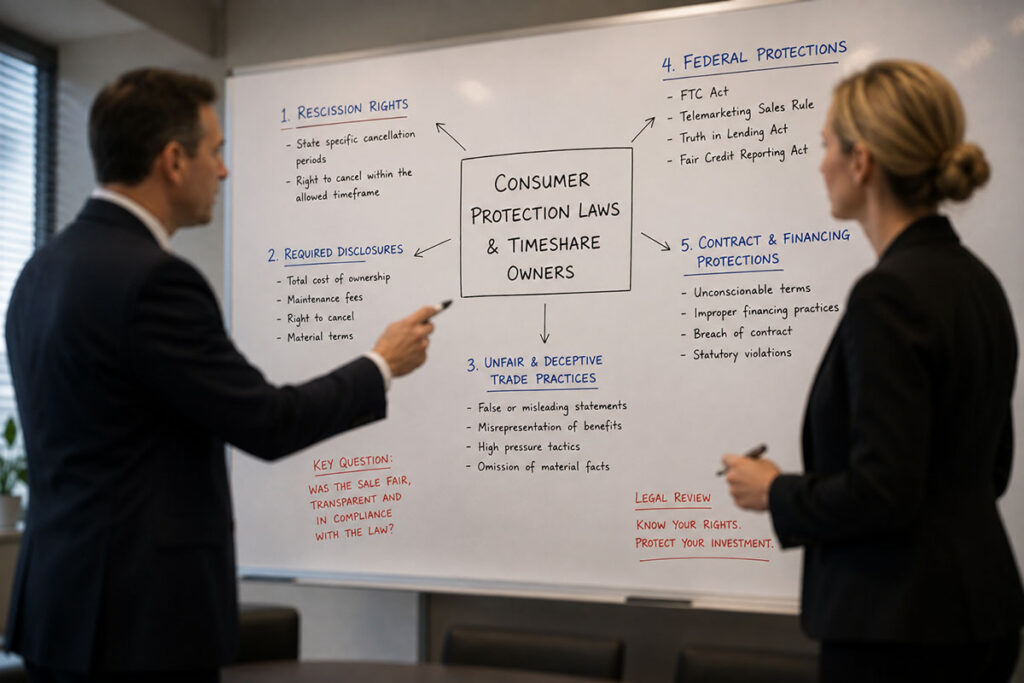
Every state has its own consumer protection laws, and most also have statutes that specifically regulate the sale of timeshares.
These laws frequently address issues such as:
- Required disclosures before purchase
- Advertising and marketing practices
- Sales presentation requirements
- Cancellation rights
- Escrow requirements
- Public offering statements
- Developer registration
- Other protections established under state law
Because these requirements vary from one state to another, understanding which laws apply usually begins with determining where the purchase occurred and reviewing the documents provided during the transaction.
Your Right to Cancel a Timeshare May Be Limited
One of the most important consumer protections available to timeshare purchasers is the statutory rescission period. Every state that regulates timeshare sales provides buyers with a limited period to cancel a newly purchased timeshare without penalty. Depending on the state, that period may last only a few days.
Equally important, each state establishes specific procedures that must be followed to exercise that right successfully. Missing the rescission deadline does not automatically eliminate every legal option. It does, however, remove one of the simplest methods available for canceling a purchase.
Consumer Protection Goes Beyond the Rescission Period
Many owners believe that once the cancellation period expires, they have no legal rights.
That is not necessarily true.
Depending on the circumstances, other consumer protection laws may still become relevant. Every situation depends on the facts, but an attorney may review issues involving:
- Material representations made during the sales presentation
- Required disclosures provided before purchase
- Financing arrangements
- Advertising and promotional materials
- Telemarketing practices
- Contractual language
- Other facts unique to the transaction
Evaluating these issues requires more than simply reading the contract. It involves reviewing the entire purchase process from the initial invitation through the closing documents.
Federal Consumer Protection Laws May Also Apply
Although timeshare ownership is largely governed by state law, certain federal laws may also become relevant depending on the circumstances. Federal statutes addressing telemarketing, credit reporting, financing practices, debt collection, electronic communications, and consumer privacy can intersect with timeshare ownership in ways many consumers do not expect.
Whether those laws apply depends entirely on the facts surrounding the transaction and any issues that developed after the purchase.
Every Timeshare Purchase Is Different
No two timeshare purchases are exactly alike. The developer, state law, financing, purchase date, ownership structure, sales presentation, and written contract may all influence the legal issues involved. What applies to one owner may not apply to another.
That is why relying solely on internet forums or another owner’s experience often leads to confusion. Every ownership should be evaluated based on its own facts and documentation.
Why Timeshare Legal Experience is Important
Consumer protection laws can be highly technical, particularly when they intersect with state-specific timeshare statutes. An experienced timeshare attorney does far more than review a contract.
An attorney should be able to evaluate the entire transaction, including the sales presentation, written disclosures, financing documents, correspondence, governing documents, and applicable consumer protection laws to determine whether legal remedies may exist. That comprehensive review often provides a much clearer understanding of an owner’s legal position than relying on generalized information found online.
Frequently Asked Questions
What consumer protection laws apply to timeshare purchases?
The answer depends on where the purchase occurred, the applicable state timeshare statutes, and the specific facts surrounding the transaction. Federal consumer protection laws may also apply in certain situations.
What happens if my rescission period has expired?
Although the statutory cancellation period may have ended, other legal issues may still be reviewed depending on the facts surrounding the purchase.
Can consumer protection laws apply to misleading sales presentations?
Depending on the circumstances, yes. An attorney can review the sales presentation, written documents, and applicable law to determine whether legal issues may exist.
Do federal laws apply to timeshare purchases?
They can. Certain federal consumer protection statutes involving telemarketing, financing, credit reporting, and debt collection may become relevant depending on the circumstances.
Why should I have my timeshare reviewed by an attorney?
An attorney can evaluate your purchase documents, sales presentation, financing, and the applicable consumer protection laws to explain your legal rights and the options that may be available based on your individual circumstances.
Final Thoughts
Consumer protection laws were created to help ensure consumers receive accurate information before making important financial decisions. When questions arise about how a timeshare was marketed, financed, or sold, those laws may become an important part of evaluating whether legal remedies are available.
If you have concerns about your timeshare purchase or believe important information was misrepresented or omitted during the sales process, an experienced timeshare attorney can review your documents and explain the legal options that may apply to your situation.
Disclosure
This article is provided for general informational purposes only and should not be construed as legal advice. Every timeshare purchase involves unique facts, contractual terms, and applicable state and federal laws.
About Finn Law Group
Led by timeshare attorneys J. Andrew Meyer and Michael D. Finn, whose combined legal experience exceeds 75 years, Finn Law Group is a national law firm dedicated to representing timeshare owners and consumers in matters involving deceptive sales practices, timeshare cancellation, consumer fraud, credit reporting, debt collection, and other consumer protection issues.
If you have questions about your timeshare purchase or would like an experienced timeshare attorney to review your situation, contact Finn Law Group for a free consultation by calling 727-214-0700 or emailing contact@finnlawgroup.com.
Follow Finn Law Group on X for the latest consumer protection news, timeshare legal updates, and educational resources designed to help consumers better understand their rights.