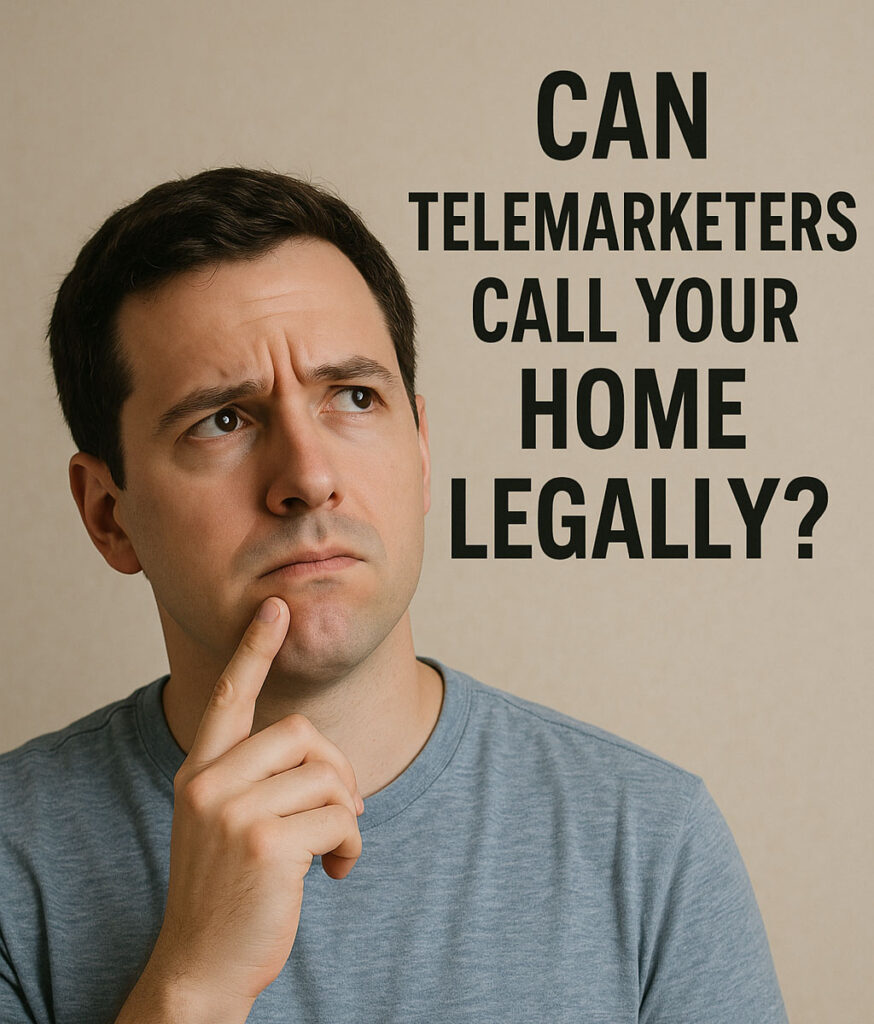
Can Telemarketers Call Your Home Legally?
Understanding the TCPA and Your Right to Privacy
 The Telephone Consumer Protection Act (TCPA) is a federal law designed to stop unwanted telemarketing calls. It protects people from being disturbed by robocalls, spam texts, and repeated sales pitches at home. Under the TCPA, businesses can’t make marketing calls to residential phone numbers that are listed on the National Do-Not-Call (DNC) Registry. The law also lets consumers sue for damages if telemarketers ignore these rules.
In simple terms, the TCPA gives you the right to say “Don’t call me”—and businesses are legally required to listen.
Why “Residential Use” Matters Under the Law
The TCPA’s DNC protections only apply to residential lines, meaning your home phone or personal cell number.
If a phone is used mainly for business, it might not be protected the same way. Courts often look at how the number is used day-to-day—whether it’s tied to a home or business. This detail can make or break a case when consumers sue telemarketers for calling after being told not to. A recent court case showed that not every phone number can be treated the same. The judge explained that figuring out whether a call broke the rules depends on how each number is used—and that makes group (class-action) lawsuits hard to prove.
How Telemarketers Try to Get Around the Rules
 Telemarketers often claim they had permission to call you. Under the law, there are three main exceptions that let them make calls:
- You gave consent — You agreed to be called or texted.
- You have an established business relationship (EBR) — You recently bought something or asked about a product.
- It’s not a sales pitch — Calls for surveys, political messages, or certain non-profits may not count as “telemarketing.”
Even with these exceptions, once you say “Take me off your list,” the caller must stop—and they must keep your number on their internal do-not-call list for at least five years.
Recent Ruling Makes Class Actions Harder—but Your Rights Still Stand
A federal court recently ruled that class-action lawsuits under the TCPA’s Do-Not-Call rules are difficult to certify because every consumer’s situation is different.
In the case Schmitendorf v. Juicy’s Vapor Lounge, the court said it’s nearly impossible to prove that all numbers on a telemarketing list were residential or called without consent. That doesn’t mean consumers lose their rights—it just means individual cases may be more effective than group lawsuits.
So while big “class actions” may be less common, you can still take a telemarketer to court if they violate the law and seek $500 to $1,500 per illegal call or text.
What You Can Do to Protect Yourself
Here are simple steps you can take to reduce unwanted calls:
- Register your number on the National Do-Not-Call Registry.
- Don’t engage—hang up immediately on suspicious or robotic callers.
- Never share your number with unknown websites or “free offer” forms.
- File complaints with the FTC or FCC if calls persist.
- Keep a record of dates and numbers for repeat violators—you may be eligible to sue.
Final Thoughts: You Have the Right to Be Left Alone
 The Telephone Consumer Protection Act (TCPA) was created to protect your peace, privacy, and personal time from unwanted intrusions. Even as telemarketers continue to evolve their tactics—using robocalls, text blasts, and AI-assisted dialing—the law still empowers you to take action.
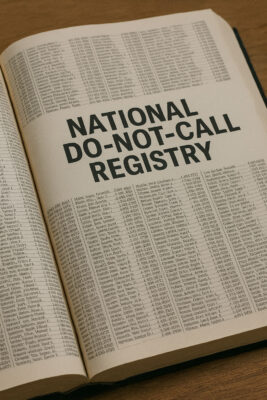
If your number is listed on the National Do-Not-Call Registry and you still receive repeated sales calls, you are not powerless. Keep a record of who called, when, and what was said. These details matter when reporting violations to regulators or when deciding to pursue legal action. Your phone is your space—your permission must be respected.
The message remains clear: “No means no,” even over the phone.
When to Consider Retaining an Attorney
For many consumers, unwanted calls are more than a nuisance—they can feel like harassment. If a telemarketer or company repeatedly calls you despite being on the Do-Not-Call list or after you’ve told them to stop, it may be time to speak with an attorney who handles TCPA cases.
A qualified consumer protection attorney can:
Review your call records and verify whether the TCPA applies.
Send cease-and-desist letters or initiate claims on your behalf.
Pursue statutory damages of $500 per illegal call—or up to $1,500 per call if the violations were willful or knowing.
Help you navigate settlement options or collective actions if others were affected.
Legal professionals experienced in consumer law can explain your rights, gather evidence, and help ensure telemarketers are held accountable under federal law.
Disclosure
This article is provided for general informational purposes only and does not constitute legal advice or create an attorney–client relationship. Readers should not act or refrain from acting based on this content without first consulting a qualified attorney regarding their specific situation. The TCPA and related state laws may vary, and outcomes depend on the facts of each case.
Led by attorneys J. Andrew Meyer and Michael D. Finn with over 75 years of combined legal experience. The Finn Law Group is a national consumer protection firm that specializes in Timeshare Law. If you feel you need the services of a timeshare attorney, contact our law firm today at 855-FINN-LAW. Want to learn more on timeshare related issues? Follow us on X formally Twitter.