
What Is a Deeded Timeshare?
 A deeded timeshare is a form of vacation property ownership that gives you legal rights to a specific unit, resort, or week of use. Unlike some modern timeshare programs that operate more like memberships, a deeded timeshare is real property — meaning you have an actual, recorded deed in your name. This deed is typically recorded in the county where the resort is located, just like a traditional home or condo.
Understanding what deeded represents — and what it means for you as an owner — can help you make informed decisions about buying, using, or selling a timeshare.
The Basics of a Deeded Timeshare
 When you purchase a deeded timeshare, you’re essentially buying a fraction of real estate. This fraction corresponds to the amount of time you can use the property each year, usually in one-week increments.
For example, if you own a 1/52 interest, you have the right to occupy the unit for one week each year. Your ownership is perpetual — it does not expire after a set number of years — unless you choose to sell, transfer, or bequeath it.
This is different from “right-to-use” or “points-based” timeshares, where you do not own real property but instead have a contractual right to use accommodations for a certain number of years.
What the Deed Represents
A timeshare deed is a legal document that:
- Names you as the property owner – Your name (and any co-owners) is recorded on the deed.
- Describes the property – The resort name, unit number (or floating unit category), and week number (or season) are specified.
- Outlines ownership rights – It defines your right to occupy, rent, exchange, or sell your week.
- Carries legal responsibilities – It ties you to obligations such as paying annual maintenance fees, property taxes, and any special assessments.
Because the timeshare deed is legally recorded, your ownership rights are protected by state real estate laws. This also means that if you fail to meet your financial obligations, the resort can place a lien on your property and foreclose, just like with other real estate.
Ownership Rights You Gain
A deeded timeshare gives you the same core rights as any real property owner:
- The right to occupy your designated week or season.
- The right to rent out your week to someone else.
- The right to exchange your week through a timeshare exchange company.
- The right to sell or gift your ownership to another person.
- The right to pass it down to heirs through your will or estate plan.
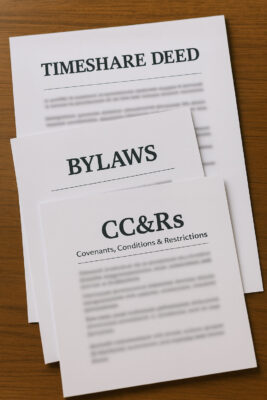
These rights, however, are also balanced with certain restrictions found in the resort’s governing documents, such as homeowners’ association (HOA) bylaws and the timeshare declaration.
Responsibilities That Come With the Deed
 Along with ownership rights, you take on ongoing obligations:
- Annual maintenance fees – Cover resort upkeep, staffing, utilities, and repairs.
- Property taxes – Either billed separately or included in your maintenance fees.
- Special assessments – Additional charges for major renovations or unexpected repairs.
- HOA Rule compliance – Adhering to resort rules on occupancy, renting, and usage.
These responsibilities can be legally binding and can increase over time, regardless of whether you use your timeshare in a given year.
Selling or Transferring a Deeded Timeshare
Because it’s real property, a deeded timeshare can be sold, gifted, or donated — but the process isn’t always simple. You must:
- Find a buyer – Timeshares often have low resale value, so demand can be limited.
- Prepare a deed transfer – A new deed must be prepared, signed, and notarized.
- Record the transfer – The deed must be recorded in the local county records.
- Notify the resort – The resort’s HOA or management must approve and update their records.
Some owners choose to use licensed real estate agents or attorneys who specialize in timeshare transfers to ensure the process is handled correctly.
 Pros of a Deeded Timeshare
- Real property ownership – Legal protections under state real estate laws.
- Perpetual use – No expiration date on your ownership rights.
- Transferability – Ability to sell, gift, or bequeath the property.
- Exchange opportunities – Eligible for many exchange company programs.
Cons of a Deeded Timeshare
- Ongoing costs – Maintenance fees and taxes can rise over time.
- Difficult resale market – Resale prices are often much lower than original purchase prices.
- Long-term commitment – You remain responsible for the property unless you successfully transfer ownership.
- Limited flexibility – Fixed weeks or seasons may not match your vacation needs.
Deeded Timeshare vs. Points-Based Programs
Today, many developers have shifted toward points-based systems where you purchase points that can be used for reservations at multiple resorts. While flexible, points systems often do not give you a deeded interest in real estate.
A deeded timeshare offers stability and a legal property record, but points programs can offer more booking options. Some owners prefer the certainty of a deeded week at their favorite location, while others want the variety of a points-based approach.
Final Thoughts on Deeded Timeshare
A deeded timeshare is real estate. You own a fraction of a property, recorded in your name, with all the rights and responsibilities that come with ownership. This means:
- You have the right to use, rent, sell, or pass on your timeshare.
- You are legally responsible for ongoing fees and obligations.
- Your ownership continues until you choose to transfer it or pass it to your heirs.
Understanding these facts can help you make better decisions — whether you’re considering buying, managing, or selling a deeded timeshare.
Disclosure: This article is intended for informational purposes only and should not be considered legal advice. Images included are used for illustrative and artistic purposes only and do not depict actual individuals, events, or specific locations.
____________________________________
Led by timeshare attorneys J. Andrew Meyer and Michael D. Finn with over 75 years of combined legal experience. The Finn Law Group is a national consumer protection firm that specializes in Timeshare Law. If you feel you need the services of a timeshare attorney, contact our law firm today at 855-FINN-LAW. Want to learn more on timeshare related issues? Follow us on X formally Twitter.