
Investigative Report Uncovers Timeshare Marketing Practices
At a time where consumers are more informed and connected than ever, it’s puzzling to witness the continued use of outdated marketing strategies that hinge on deception. Investigative news reporter Jennifer Krause from News Channel 5 recently shed light on how some companies still employ bait-and-switch tactics, leaving customers feeling misled and questioning the integrity of these marketing practices. Let’s look at how this investigative report uncovers timeshare marketing practices.
News Investigation Reveals Marketing Program
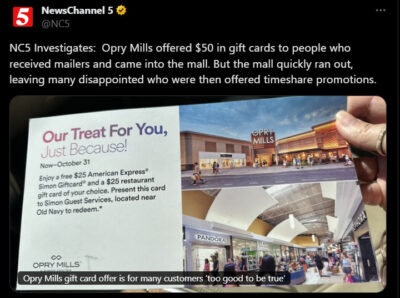 Prompted by consumer complaints, Krause launched an undercover investigation into a promotional offer at a prominent Nashville shopping center.
The mall had sent out postcards that promoted what seemed like a generous deal: “Our Treat for You – Just Because.” Shoppers who were mailed the postcard eagerly showed up at the mall, expecting to enjoy the advertised reward of two $25 gift cards.
Going Undercover
Krause’s undercover video footage unveiled a starkly different reality. When customers attempted to collect their free gift cards, they were informed that the promotion, originally set to run from the start of October until the month’s end, had unexpectedly concluded a week early. Mall patrons were told other gifts were available however there was an unexpected requirement—they had to sit through a video presentation by a timeshare company to receive an alternate incentive – a travel voucher. This stipulation was not disclosed in the initial promotion, catching many shoppers off guard.
Consumer Reactions to News Investigation
 In interviews conducted by Krause, mall customers expressed frustration and disappointment. One shopper stated, “I saw so many people come up with their card and them turning them away and trying to convince them to do the video. I just felt like that’s wrong to do that to people.” The initial excitement appeared to have turned into a sense of betrayal, damaging the trust between consumers and the businesses involved.
A Classic Bait-and-Switch Scenario
The scenario appears to be a textbook example of the bait-and-switch tactic: lure customers with an appealing offer and then change the terms or add unforeseen conditions once they are committed. Such practices not only erode consumer trust but also risk long-term reputational damage, especially in a period where word-of-mouth spreads rapidly through social media and online reviews and attracting a TV news investigation.
Why Companies Persist with Questionable Strategies
 Krause’s investigation raises the question: why do some companies persist with these questionable strategies? One reason may be the immediate, albeit short-lived, spike in customer engagement. By attracting a large number of potential customers with an attractive offer, businesses hope to convert a fraction of them into sales through additional pitches or upselling during the obligatory presentations.
Another factor is the competitive landscape. With countless brands vying for consumer attention, some companies resort to flashy promotions to stand out, even if it means bending ethical guidelines. They bank on the notion that a significant reward will overshadow any potential backlash from the hidden stipulations.
The Demand for Transparency in Marketing
However, these types of marketing tactics ignore a vital aspect of modern consumer behavior: the demand for transparency and authenticity. Today, customers are not just more informed—they’re also more watchful. They quickly notice and publicly call out what they feel are dishonest practices, often sharing their negative experiences. This collective reaction amplifies the issue.
The recent episode about the postcard investigation illustrates this perfectly. Watched by tens of thousands of people, it quickly spread as viewers shared and discussed it across various social media platforms. This widespread attention not only highlighted the specific incident but also sparked a larger conversation about ethical marketing practices.
Potential Legal Implications
Moreover, relying on bait-and-switch strategies can lead to legal troubles. Consumer protection laws in many regions prohibit misleading advertising and require clear disclosure of any conditions attached to promotional offers. While some vacation companies operate in what could be considered a legal gray area with their marketing tactics, they risk not only damaging their reputation but also facing legal penalties by engaging in practices that may be deemed deceptive.
What to Do If You Feel Scammed by a “Too Good to Be True” Offer
 If you suspect you’ve been scammed by an offer that seemed too good to be true, it’s important to act promptly. Begin by collecting all relevant documentation, including emails, contracts, receipts, and any promotional materials associated with the offer. Reach out to the company directly to express your concerns and seek a resolution; sometimes, issues can be resolved through direct communication. If the company is unresponsive or unhelpful, report the incident to consumer protection agencies or regulatory bodies, such as the Federal Trade Commission.
If you’ve provided any financial information, notify your bank or credit card company immediately to monitor activity and prevent unauthorized transactions. Sharing your experience on consumer review websites or social media can also help warn others about a potential scam. Lastly, consider consulting with a legal professional to explore any options for recovering your losses or taking further action.
Final Thoughts
As consumers, it’s important to remain cautious: if an offer seems too good to be true, it often is. No one gives out free anything without expecting something in return. There’s always a hook, and we must be mindful of what’s behind these so-called free gifts. While bait-and-switch tactics might yield temporary gains for businesses, they are largely ineffective in building genuine customer loyalty. Companies could benefit more from innovative yet honest marketing strategies that respect our intelligence and time. In a world where trust is a precious commodity, sincerity isn’t just ethical—it’s good business.
*Update: Mall agrees to work with all customers who could not redeem gift card promotion.
Disclosure: This article is written for informational purposes and is not intended as legal advice.
______________________
Led by Timeshare Attorneys J. Andrew Meyer and Michael D. Finn with over 75 years of combined legal experience. The Finn Law Group is a national consumer protection firm that specializes in Timeshare Law. If you feel you need the services of an attorney, please feel free to reach out to us for a free consultation to discuss your individual circumstances. Call 855-FINN-LAW or email us for an appointment at info@finnlawgroup.com | Looking for more on Timeshare? Follow us on Twitter X.