Enforcement Coming Again to the Timeshare Exit Industry
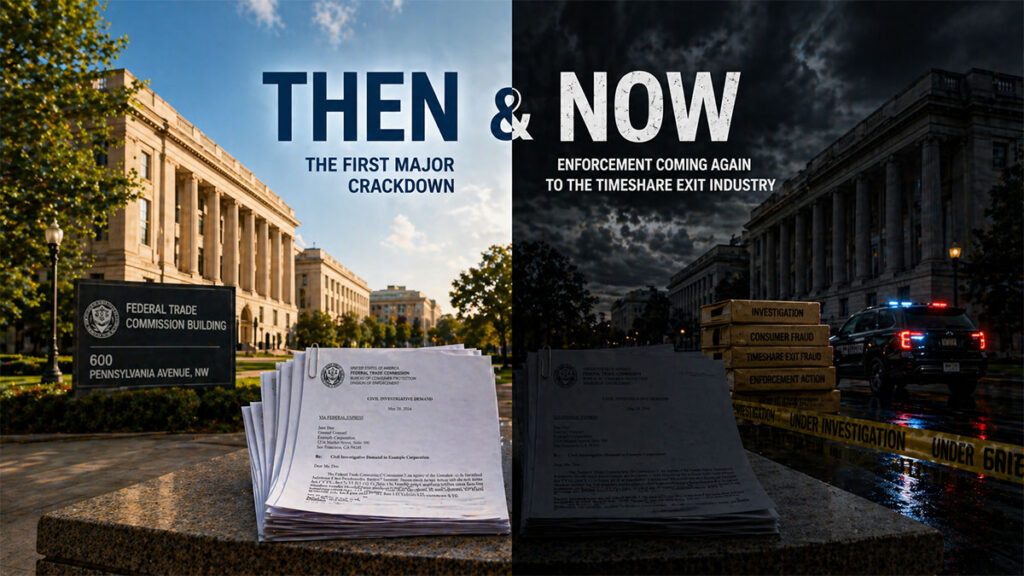
More than a decade ago, state and federal regulators launched one of the largest coordinated crackdowns in the history of the timeshare exit industry. It was a sweeping response to widespread fraud, empty promises, and devastating financial losses suffered by timeshare owners across the country. Today, many signs suggest that history is about to repeat itself.
The secondary market, now often branded as the “timeshare exit” industry, remains filled with unlicensed operators and fraudulent bad actors. While the sales pitch has evolved, the harm to consumers looks painfully familiar. For many in the consumer protection community, including attorneys dedicated to this space, the current environment feels like Timeshare Scam 2.0.
A Look Back at the First Major Crackdown
The scale of prior enforcement action was historic. The Federal Trade Commission (FTC) along with international partners filed 191 actions to stop fraudulent operations selling timeshare property resale services, including three FTC cases, 83 civil actions brought by 28 states, and 25 actions brought by law enforcement agencies in 10 other countries. More than 184 individuals face criminal prosecution by U.S. Attorneys and local law enforcement.
This coordinated effort involved federal agencies, state attorneys general, and international law enforcement. Regulators alleged that timeshare resale companies were charging large upfront fees while falsely promising to resell timeshares or secure travel. In most cases, the promised resale never happened. Consumers lost thousands of dollars. Many victims were seniors living on fixed incomes.
At the time, regulators made it clear that upfront fee resale schemes were a serious and growing threat. They warned owners to be skeptical of any company that demanded payment before delivering results. Unfortunately, the warning signs did not end the problem.
The Evolution Into “Timeshare Exit” Services
In the years since that enforcement wave, the resale market has largely collapsed. It is now widely known that many timeshare interests have little to no resale value. Online listing platforms are filled with listings for one dollar or less. Some owners are even offering to give away their interests simply to escape ongoing maintenance fees.
As resale opportunities declined, a new industry emerged. Instead of promising to sell the timeshare, companies began promising to “cancel,” “terminate,” or “exit” the contract. While some of the marketing language has changed. The structure often did not.
Many timeshare exit companies charge large upfront fees, sometimes ranging from several thousand to tens of thousands of dollars. They claim to use proprietary strategies or legal teams. In many cases, however, they are not law firms. They are not licensed to practice law. Some are simply referral operations that outsource work to unknown third parties.
A number of groups that operated in the resale era have reappeared in this evolved space. The tactics have shifted, but the underlying model of collecting upfront offering guaranteed results has remained. This is why many in the consumer protection community describe the current environment as a second wave.
Why Enforcement Is Likely to Happen Again
There are several reasons why another major enforcement cycle appears likely.
First, regulators have never stopped warning consumers about timeshare scams. State attorneys general across the country routinely issue alerts about timeshare resale and exit fraud. The FTC continues to publish guidance warning against companies that demand upfront fees or make guarantees that sound too good to be true.
Second, media coverage has remained steady. Local news outlets frequently report on seniors who lost thousands of dollars to exit companies that failed to deliver. National consumer reporting organizations continue to highlight the risks associated with the secondary market.
Third, the economic pressure on timeshare owners has increased. Maintenance fees continue to rise. Special assessments are becoming more common. Owners who feel trapped are more vulnerable to high pressure exit pitches. Fraud often follows financial distress.
Finally, regulators tend to act when a pattern becomes clear. When complaints rise, when consumer losses become measurable, and when certain operators appear repeatedly in reports, enforcement follows.
The prior crackdown shows that regulators are willing to coordinate across state lines and even internationally. There is no reason to believe they will hesitate to do so again if the evidence supports it.
The Opaque Nature of the Timeshare Exit Industry
One of the most concerning aspects of the current landscape is the lack of transparency.
Many timeshare exit companies do not clearly disclose who is performing work or what type of work occurs. They may use marketing language that implies legal representation without actually providing licensed attorneys. Some require consumers to sign contracts with strict non-disclosure provisions. Others advise consumers to stop communicating with their resort or developer, which can lead to default and credit damage. This opacity makes it difficult for consumers to evaluate risk. It also raises red flags for regulators.
When large sums of money are collected upfront, when success rates are unclear, and when complaints begin to surface in significant numbers, scrutiny increases.
What Timeshare Owners Should Understand
It is now widely recognized that many timeshares have little or no resale value. That reality has changed the conversation. Owners are no longer searching for profit. They are searching for relief. That emotional and financial vulnerability creates an environment where bad actors can thrive.
Consumers should understand several key points:
- Be cautious of any company demanding large upfront fees with guaranteed outcomes.
- Verify whether the company is a licensed law firm if legal services are being advertised.
- Research complaint history through state regulators and consumer protection agencies.
- Be wary of pressure tactics and time-limited offers.
Most importantly, owners should know that not every exit solution is the same. Legitimate legal options may exist depending on the specific facts of the timeshare purchase and the conduct involved. However, those options should be evaluated carefully and transparently.
The Role of Consumer Protection and Timeshare Attorneys
Attorneys who focus on timeshare matters have seen this cycle before. The patterns are familiar: inflated promises, upfront fees, disappointed clients, and ultimately, regulatory complaints.
The prior FTC enforcement action shows that large-scale intervention is possible when misconduct becomes widespread. In today’s environment, many believe another coordinated effort may be approaching. As markets grow more complex and less transparent, consumers are often left exposed, creating opportunities for bad actors to take advantage. History has shown that when this happens, regulators eventually step in to restore balance. The question is no longer whether scrutiny will return. It’s when.
_____________________________________________________________________
Disclosure: This article is for general informational purposes only and does not constitute legal advice. You should consult a qualified timeshare attorney for advice specific to your situation.
Led by timeshare attorneys J. Andrew Meyer and Michael D. Finn with over 75 years of combined legal experience. The Finn Law Group is a national consumer protection firm that specializes in Timeshare Law. If you feel you need the services of a timeshare attorney, contact our law firm today at 855-FINN-LAW. Want to learn more about timeshare related issues? Follow us on X, formally Twitter.