

How Timeshare Points Replaced Deeded Shoulder Seasons
From Color-Coded Seasons to a Numbers Game
 In the early years of timesharing, inventory was divided into simple blocks of time. Developers branded these with colors: Red Season meant prime weeks, while Blue or White Seasons covered off-peak or “shoulder season” weeks.
On paper, this looked straightforward. In practice, it was a lopsided system. Owners locked into Blue or White weeks often found their vacation time carried little weight in the exchange marketplace.
Trading up for a Red Season week was rarely possible without jumping through hoops or paying extra. Meanwhile, Red Season owners enjoyed prime access, reinforcing the idea that some timeshares were simply worth more than others. This imbalance was no small issue. Many owners who bought into shoulder seasons eventually felt shortchanged, their vacation ownership a poor bargain compared to the glossy promises at the sales table.
Enter Points Programs a Convenient “Fix”
 The solution, according to developers, was to replace the color-coded week system with points-based vacation clubs. Each resort, unit size, and season was assigned a point value tied to demand. High-demand weeks carried higher point costs, while shoulder seasons required fewer points.
On the surface, this seemed like an upgrade:
- Flexibility: Owners weren’t stuck with a single week. Points could be used for different resorts, unit types, or even banked and borrowed across years.
- Balance: Inventory was rationed based on demand instead of rigid “Red” vs. “Blue” divisions.
- Access: Owners had at least the illusion of more choice.
But let’s be clear, this shift wasn’t entirely about fairness. Developers gained significantly more control under these “Right to Use” (RTU) style points programs. Points gave them the power to constantly adjust charts, revalue seasons, and introduce new restrictions. What looked like flexibility for owners often translated into higher costs and more sales opportunities for the developer.
What This Really Meant for Owners
 For owners of multi-site timeshare programs, the transition came with trade-offs:
- Shoulder Season Relief: Owners who once held undervalued Blue or White weeks finally had something closer to equity. Points could be saved, combined, and stretched further.
- Developer Leverage: The power to assign and reassign point values rested squarely with the company. Owners had little say when charts were revised, which often made prime weeks harder to reach.
- Illusion of Flexibility: While timeshare brochures highlighted endless possibilities, in practice, availability still depended on competition, booking windows, and developer-set rules.
So yes, shoulder season owners gained more options, but often only within the confines of a timeshare system where the developer controlled the terms.
Final Thoughts
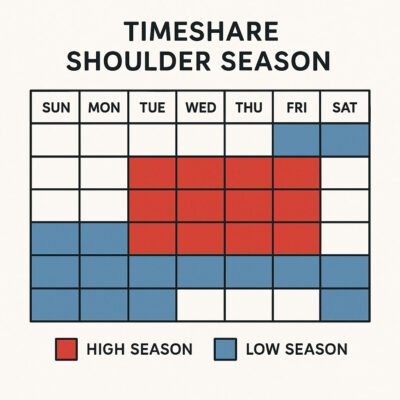 Shoulder season, once relegated to “Blue” or “White” categories, was recast under the points era as part of a seemingly fairer system. Yet the move wasn’t purely about helping owners. By shifting to RTU-based points programs, developers restructured the game in ways that gave them more control over inventory, pricing, and long-term revenue streams.
For many owners, points programs did level the playing field. But make no mistake: the house still sets the rules, and it rarely does so without its own interests front and center.
Disclosure
This article is provided for general informational purposes only and does not constitute legal advice or create an attorney–client relationship.
Led by attorneys J. Andrew Meyer and Michael D. Finn with over 75 years of combined legal experience. The Finn Law Group is a national consumer protection firm that specializes in Timeshare Law. If you feel you need the services of a timeshare attorney, contact our law firm today at 855-FINN-LAW. Want to learn more on timeshare related issues? Follow us on X formally Twitter.