
TCPA Ruling Gives Consumers More Say
What Is the Telephone Consumer Protection Act (TCPA)?
The Telephone Consumer Protection Act, or TCPA, is a federal law designed to protect your privacy from unwanted robocalls, texts, and faxes. Enacted in 1991, it gives you the right to control who can contact you—and how.
Under the TCPA, most businesses cannot send marketing calls, automated texts, or fax advertisements unless you have given clear permission. This means:
- No pre-recorded sales calls without your consent
- No spam faxes cluttering your inbox or machine
- No automated text blasts you never signed up for
If a business breaks these rules, the law gives you the right to take action, including pursuing damages in court.
Why the Latest Supreme Court Decision Matters
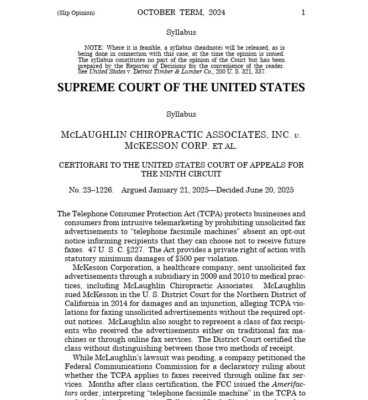 In the case of McLaughlin Chiropractic Associates v. McKesson Corp., the U.S. Supreme Court made a major change in June of 2025 in how the TCPA is interpreted.
Here’s the shift:
- Before: Courts often deferred to the Federal Communications Commission (FCC) when deciding what the TCPA meant. If the FCC had issued a ruling—such as defining what counts as an auto-dialer or setting the standard for “prior express consent”—courts tended to follow it without much question.
- Now: Judges have full authority to make their own decisions about what the law means—unless Congress has clearly given that power to an agency like the FCC.
Why this matters for consumers:
This ruling puts the final say in the hands of the courts, not just a federal agency, and that shift has real-world consequences. With district courts no longer bound to follow the FCC’s prior interpretations, there will likely be renewed interest in TCPA litigation.
Defendants—such as telemarketers, debt collectors, mass texters, and fax advertisers—are expected to challenge long-standing FCC definitions, including:
- What qualifies as an auto-dialer? Courts may now revisit whether certain dialing technologies fall under TCPA restrictions.
- What counts as “prior express consent”? Judges may scrutinize whether consent was given clearly enough—or if it was buried in fine print.
 For consumers, this means a stronger and more direct path to seek justice when your privacy is invaded. Your case will now be decided on how your specific facts fit the law—directly in court.
How the TCPA Shapes Your Protection
The TCPA gives you control over your personal phone line and digital communication. The recent ruling makes that protection even stronger by removing an extra layer of interpretation that could sometimes delay or complicate consumer claims.
Because judges are now making these calls directly, you may see:
- Less Confusion: Courts can apply a more consistent standard across cases.
- More Access to Justice: Your case is decided based on the law and your facts—not an agency’s prior opinion.
Debt Collection Calls Are Covered by the TCPA
 Debt collectors, whether collecting on their own behalf or for another company, must follow the TCPA when using auto-dialers, pre-recorded voice messages, or text messages to contact you.
If they’re calling your cell phone with these methods, they must have your prior express consent.
Calls to landlines are treated differently: prerecorded or artificial voice calls to a residential landline generally require consent unless the call is purely informational and not for telemarketing.
How a Consumer Protection Attorney Can Help
Knowing your rights is one thing—enforcing them is another. A skilled consumer protection attorney can:
- Assess your situation to see if you have a valid TCPA claim
- Preserve and gather evidence such as call logs, voicemails, and fax records
- File and pursue legal action within the strict timelines set by law
- Negotiate or litigate for damages, which can reach up to $500 per violation—or $1,500 per violation if the conduct was willful
With the TCPA, you’re not just stopping the calls—you’re holding the offenders accountable.
Final Thoughts on the TCPA
Unwanted robocalls, spam texts, and junk faxes aren’t just irritating—they’re often illegal. The TCPA is a powerful tool designed to protect your peace and privacy. The latest Supreme Court decision strengthens that shield by giving judges—not just federal agencies—the final say on how the law applies.
If you’ve been targeted by persistent or unwanted communications, expect to see more court challenges to the tactics used by telemarketers and mass advertisers. With the right legal guidance, you can use the TCPA to stop the harassment, recover damages, and protect your privacy for good.
Disclosure: This article is intended for informational purposes only and should not be considered legal advice. Images included are used for illustrative and artistic purposes only and do not depict actual individuals, events, or specific locations.
____________________________________
Led by attorneys J. Andrew Meyer and Michael D. Finn with over 75 years of combined legal experience. The Finn Law Group is a national consumer protection firm that specializes in Timeshare Law. If you feel you need the services of a timeshare attorney, contact our law firm today at 855-FINN-LAW. Want to learn more on timeshare related issues? Follow us on X formally Twitter.