
Timeshares can range widely in price, but the purchase price is only one part of the total cost. Buyers need to consider annual maintenance fees, financing charges, special assessments, and other ongoing expenses that add up quickly. The total cost over the life of ownership can be substantially higher than what you see at the sales presentation.

How Much Do Timeshares Cost Upfront?
Timeshare prices are rarely published in a catalog. Developers typically do not disclose pricing upfront, and buyers only learn the actual cost during a guided tour. Sales presentations often pitch timeshares in the $25,000 to $30,000 range, but the final number depends on the sales environment, the unit type, and how responsive you are to closing the deal. Because salespeople work entirely on commission, their income hinges on securing a sale—and the bigger the sale, the better. This built-in incentive often leads to inflated price quotes and aggressive upselling.
What Does a Timeshare Cost Each Year?
Owning a timeshare means paying annual maintenance fees that are legally binding and rarely optional. These fees can range from a few hundred to several thousand dollars per year, and they often increase over time regardless of whether you use the property. In many cases, owners attempt to resell their contracts online for a fraction of the original price—sometimes just a few dollars or even as low as $1. However, even a “free” timeshare in the secondary market still carries those ongoing annual maintenance fees. Far from adding value, these fees are one of the main reasons why many timeshare owners seek to exit their contracts altogether.

How the Timeshare Sales Process Drives Higher Costs
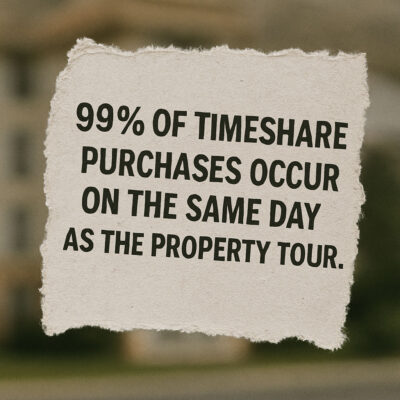
The timeshare sales model is engineered for speed and psychological influence. From the moment you enter a resort’s sales center, you are guided through a well-choreographed presentation that typically culminates in an intense push to sign on the dotted line the same day. Industry data reveals that upwards of 99% of timeshare purchases occur on the same day as the property tour. This is no coincidence. Sales teams frequently deploy “Today Only” offers and deep discounts tied to immediate decisions, creating a sense of urgency that discourages buyers from seeking outside advice or sleeping on the decision.
The experience is often organized into a multi-tiered process where you interact with several layers of sales personnel. It usually begins with a friendly representative who builds rapport. If you hesitate, you are often passed along to a manager trained to overcome objections. In more persistent cases, a senior executive may make a final pitch with “executive-level” incentives. At the heart of this system is a key performance metric known as VPG meaning sales—the average dollar amount in sales generated per guest presentation. In the timeshare industry, the average VPG hovers around $22,000. Because of the intense focus on closing deals quickly, buyers are rarely encouraged to pause, consult legal counsel, or compare offers.
What Are Your Options If the Costs Become Unmanageable?
When the financial burden of a timeshare becomes too heavy, owners typically consider a few paths. You might try to resell or rent the property, though the resale market is often saturated and yields little return. Some developers offer a deed-back or surrender program, but these are voluntary and not guaranteed. You can also explore Timeshare Cancellation if you recently signed a contract and are still within the statutory rescission window. Every U.S. state that regulates timeshare sales gives buyers a limited window after signing—commonly cited in the range of roughly 3 to 15 calendar or business days depending on the state—to cancel the purchase for any reason by delivering written notice to the address named in the contract. This is a state consumer-protection statute, not a federal law. The clock generally starts at contract signing or at delivery of the required disclosure statement, and the exact day count differs by state. The FTC’s separate, general Cooling-Off Rule generally does not reach on-site timeshare presentations.
If the rescission window has closed, you may still have options depending on the contract terms and applicable law. A licensed attorney can review your contract and the closing documents for a real legal basis to rescind or challenge it, apply the state’s own rescission rule, and weigh consumer-protection claims. It is important to distinguish between an unlicensed exit company and a law firm. An exit company cannot represent you in court or give legal advice, and neither can lawfully guarantee that a specific timeshare contract will be canceled. A law firm is a licensed practice bound by state bar ethics rules, subject to professional discipline, and capable of filing suit or pursuing statutory claims. If you are weighing your options, reviewing Timeshare Attorney FAQs can help you understand how legal representation works. For more background on how Consumer Protection Law applies to vacation ownership, see our page on Consumer Protection Law.
Many owners eventually consider stopping payments when the fees become unmanageable, but doing so carries serious financial risks. If you are struggling with debt, read our guide on What Happens If I Stop Paying On My Timeshare Loan? to understand the consequences before making a decision. You might also wonder how exchange networks operate; learning What is the 1 in 4 Rule for Timeshares? helps clarify why booking limits and exchange fees add to your total cost.
How Much Is a Timeshare? The Bottom Line
The price of a timeshare is rarely just the purchase price. It is the sum of the initial cost, annual maintenance fees, special assessments, and financing charges that compound over decades. The lack of a consistent pricing framework and the high-pressure sales environment make it nearly impossible for consumers to know whether they are getting a fair deal. If you are struggling with rising fees or a contract you regret, you do not have to navigate this alone. Visit Finn Law Group to learn more about our approach, or Contact Us to schedule a consultation with a licensed attorney who can review your situation and explain what options are available to you.
Frequently Asked Questions
How much does a timeshare cost per year? Annual maintenance fees can range from a few hundred to several thousand dollars, and they often increase over time regardless of usage.
Can I sell my timeshare for what I paid? The secondary market typically reflects immediate depreciation, with many listings going for a fraction of the original price or even as low as $1.
How long do I have to cancel a timeshare? Every U.S. state that regulates timeshare sales gives buyers a limited window after signing—commonly cited in the range of roughly 3 to 15 calendar or business days depending on the state—to cancel the purchase for any reason by delivering written notice.
What does VPG mean in the timeshare industry? VPG stands for Volume Per Guest. It measures the average dollar amount in sales generated per guest presentation. The industry average hovers around $22,000.
Is there a timeshare exit company that guarantees cancellation? No legitimate provider, whether an exit company or a law firm, can lawfully guarantee cancellation of a valid contract. Any such guarantee is a red flag.