

Why Timeshare Cancellation Requires Documentation
When timeshare owners decide they want out, the first question is often “What are my options?”
Before an attorney can answer that question, there is usually another one:
“What do your documents say?”
A timeshare dispute can involve events stretching across many years. There may have been an original purchase, financing, subsequent upgrades, points conversions, maintenance-fee increases, special assessments, reservation problems, communications with the developer, and perhaps previous attempts to surrender or exit the ownership.
What an owner remembers is important. But legal analysis also depends heavily on what can be established through the documents.
The purchase agreement may show what was actually bought. Sales materials may help establish how a benefit was presented. Emails can preserve conversations that would otherwise depend on memory. Account statements can establish dates and amounts. Later upgrade documents may show how the ownership changed.
Timeshare cancellation documentation helps turn the history of an ownership into something an attorney can actually evaluate.
And if you do not have every document, that does not necessarily mean you should wait before asking for help.
Start With the Document That Created the Ownership
The original purchase agreement is usually one of the first documents an attorney will want to review. That agreement can help identify the purchaser, seller, purchase date, price, financing, form of ownership, applicable contractual provisions, and other important terms.
But the purchase agreement may be only part of the file.
Depending on the timeshare, an owner may also have a deed, public offering statement, disclosure documents, association materials, trust documents, club rules, points information, reservation procedures, financing agreements, or other documents incorporated into the transaction.
This is one reason an attorney should not begin by assuming every timeshare works the same way. A deeded week can present different questions from a points-based membership. A trust interest may involve documents different from a right-to-use program. An owner who upgraded several times may have multiple transactions that need to be considered together.
Before determining how an ownership might end, you first need to understand what the owner actually owns.
The Original Purchase May Be Only the Beginning
Some timeshare owners have one purchase agreement from fifteen years ago. Others have an entire history. An owner may have purchased a fixed week, later converted it to points, bought additional points, refinanced the purchase, upgraded into another program, or signed a new agreement during a subsequent sales presentation.
Those later transactions can be important.
If you have upgraded or converted the ownership, do not gather only the newest agreement. Try to preserve the entire chain of documents from the original purchase through the most recent transaction.
That history can help an attorney determine what changed over time and which agreement may govern a particular issue. It can also help answer a question owners sometimes overlook:
Did the later transaction replace the earlier ownership, modify it, or add something new?
The answer should come from the documents, not an assumption based on what the transaction was called during the sales presentation.
Sales Materials Can Help Reconstruct What Happened
Timeshares are rarely purchased after someone simply reads a contract at home.
They are commonly sold through presentations, tours, conversations, demonstrations, brochures, charts, worksheets, and other sales materials. Years later, an owner may remember being told that the timeshare could easily be resold, that certain vacation dates would be readily available, that a particular benefit would continue, or that an upgrade would solve an existing problem.
Whether a statement has legal significance depends on the facts and applicable law. A verbal representation does not automatically create a legal claim, but neither should it automatically be ignored simply because it was not typed into the purchase agreement.
That is why owners should preserve whatever remains from the sales process.
Brochures, emails, handwritten worksheets, point charts, presentation materials, follow-up messages, and other records can help establish what information was provided at the time.
If you remember something important but do not have it in writing, document your recollection as accurately as possible. Include who made the statement, approximately when it occurred, where the conversation took place, and what you remember being said.
Be clear when a note is being reconstructed years later rather than written contemporaneously. Accuracy is more useful than trying to make the recollection sound stronger.
Keep the Financial History Too
Timeshare documentation is not limited to contracts. Maintenance-fee statements, special assessments, financing records, payment histories, and other financial documents can help establish how the ownership operated after the purchase.
Suppose an owner believes fees changed substantially from what was discussed during the sale. The current maintenance fee statement tells only part of that story. Earlier statements can show how the amount changed over time.
Financing records can also matter. An owner may have paid off the original purchase loan but still have continuing ownership obligations. Another owner may have refinanced or taken on new financing as part of an upgrade.
The attorney needs to understand those transactions separately.
What you paid for the timeshare and what you continue paying because you own it are not necessarily the same obligation.
A clear financial record can help separate the two.
Developer Communications Can Become Part of the Record
Emails, letters, portal messages, and other communications with the developer or association can become particularly useful when an owner has already tried to resolve the problem.
Perhaps the owner asked about a surrender program. Maybe there was a dispute over an assessment. The owner may have complained about reservation problems, questioned an upgrade, requested copies of documents, or asked the developer to honor something discussed during the sale.
Save those communications.
If important conversations occurred by telephone, begin keeping a simple call log. Record the date, the number called, the name or department of the person you spoke with, and a short description of the conversation.
When appropriate, follow an important telephone conversation with an email or letter confirming your understanding of what was discussed. The objective is not to manufacture evidence. It is simply to preserve the history while it is still available.
Do Not Throw Away Documents from a Previous Exit Attempt
Some owners contact Finn Law Group after they have already worked with an exit company, transfer business, resale company, or another third party.
Those documents should become part of the file too. Keep the service agreement, payment records, emails, text messages, correspondence sent on your behalf, transfer documents, and any response received from the developer.
An unsuccessful attempt to leave a timeshare does not necessarily establish that anyone acted improperly. But an attorney reviewing the current situation needs to know what has already happened.
That is particularly important if someone previously contacted the developer on the owner’s behalf or advised the owner to take action concerning payments, title, or the ownership itself.
A complete legal review should include the history of the timeshare and the history of the attempts to resolve it.
Considering Timeshare Cancellation?
Your purchase agreement, upgrades, sales materials, payment records, and developer correspondence can help an attorney understand what you purchased and what options may exist. You do not need a perfect file before asking for help.
Call Finn Law Group at 727-214-0700 or schedule a free consultation.
How Attorneys Use Timeshare Documentation
A licensed attorney reviews documents for a different purpose than someone simply processing an exit request.
The objective is legal analysis.
An attorney may examine the purchase agreement to determine what rights and obligations were created. Sales materials and communications may be compared with the written agreement. Disclosure documents may be reviewed against applicable legal requirements. Upgrade documents may be examined to understand how the ownership changed.
The attorney can then evaluate whether the facts raise questions involving the contract, disputed representations, disclosures, financing, title, statutory requirements, or other legal issues.
That does not mean every inconsistency creates a claim. It means the documents help determine which facts are legally significant and which are not.
Finn Law Group’s timeshare cancellation law practice begins with that type of document-specific analysis rather than assuming that every owner needs the same cancellation strategy.
Timeshare Attorney vs. Typical Exit Company
A timeshare attorney and a non-law-firm exit company may both ask an owner for documents, but the purpose and permissible use of those documents can be different.
A legitimate exit company may use records to communicate with a developer, evaluate a surrender opportunity, facilitate an administrative process, or perform other services within the scope of its business.
A licensed attorney can use those records to provide legal advice, interpret contractual rights, evaluate potential legal claims, and represent a client in a legal dispute when appropriate.
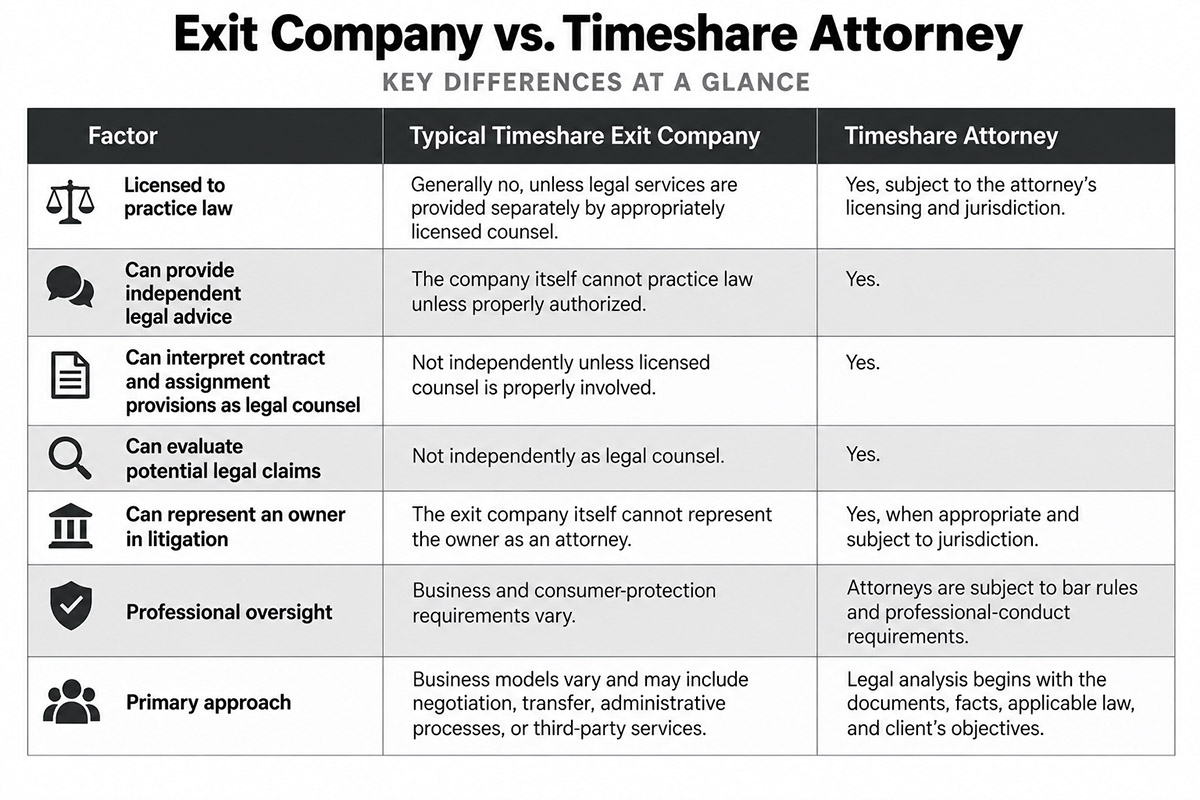
The comparison is not intended to suggest that every exit company is fraudulent or that every timeshare problem requires litigation. It explains why owners should understand whether they are purchasing an exit service or retaining legal counsel.
Finn Law Group discusses this further in its guide explaining why hiring a law firm differs from working with an exit company. The source draft similarly identifies document review as an important difference between legal representation and non-law-firm exit services.
Build a Timeline, Not Just a Stack of Paper
A box full of timeshare records can be useful. A chronological history can be better. Begin with the original purchase date. Then identify major events: financing, upgrades, conversions, significant fee changes, disputed sales representations, communications with the developer, surrender requests, previous exit attempts, and other events relevant to the ownership.
Attach documents to those events whenever possible. A timeline can help an attorney see connections that may not be obvious when looking at documents individually.
It can also be important when legal deadlines are involved.
For example, statutory rescission periods are time-sensitive and vary by jurisdiction. If an owner attempts to exercise a rescission right, the dates of the purchase, receipt of required documents, cancellation notice, and delivery can become important.
Other legal claims may have their own deadlines. Dates can matter just as much as documents.
What If Important Documents Are Missing?
Do not assume you have no options because the original purchase folder disappeared years ago. Incomplete documentation is common, particularly with older timeshares.
Start with what you have.
An old maintenance-fee statement may identify the account and ownership. A recorded deed may help establish title for a deeded interest. Emails may contain account numbers or references to earlier transactions. The developer may be able to provide copies of certain documents.
If you request documents, make the request in writing and keep a copy. An attorney may also be able to identify which missing documents are important enough to pursue and which are unlikely to affect the analysis.
The source draft correctly recognizes that an incomplete file does not automatically prevent a legal review.
Do not postpone a consultation simply because you cannot locate every piece of paper.
Sometimes determining what is missing is part of the review.
Organize the File So Someone Else Can Understand It
You do not need an elaborate filing system. Create one physical or digital folder for the timeshare. Within it, separate the original purchase, upgrades, financing, maintenance fees, developer correspondence, sales materials, and previous exit attempts.
Name electronic files clearly and include dates where possible.
Keep copies of anything you send to another party. Do not give away the only copy of an important original document unless there is a specific reason and you understand how it will be handled.
A simple chronological index can also help. The goal is not to create a legal brief before meeting an attorney.
The goal is to make the ownership history understandable.
How Finn Law Group Reviews the Documentation
Finn Law Group does not begin with the assumption that every timeshare owner has grounds for cancellation.
The review begins with the ownership, the documents, and the facts.
Attorneys may examine the purchase agreement, deed or membership structure, financing, disclosure documents, sales materials, upgrades, maintenance-fee history, developer communications, and previous attempts to resolve the ownership.
From there, the legal question becomes clearer.
Was this simply an ownership the client no longer wants? Is a developer surrender program available? Is there a dispute involving the original sale? Did later upgrades change the ownership? Are there financing or disclosure concerns? Does the documentary history raise a legal issue requiring further action?
Where supported by the facts and law, representation may involve communication, negotiation, dispute resolution, or litigation.
The documents do not determine the strategy by themselves. They give the attorney the information needed to determine what the strategy should be.
Frequently Asked Questions
What is the most important document for a timeshare cancellation review?
The original purchase agreement is often an important starting point because it helps establish what was purchased and the terms of the transaction. Depending on the ownership, deeds, disclosure documents, financing agreements, club documents, or subsequent upgrades may be equally important.
What if I lost my original timeshare contract?
Start with the documents you still have. You can also request copies of available records from the developer or other appropriate party. Do not delay seeking legal guidance solely because the original agreement is missing.
Do verbal promises matter if they are not in the contract?
Potentially. Their significance depends on the facts, applicable law, written contract, surrounding documentation, and nature of the representation. Preserve any evidence that may support your recollection rather than assuming a verbal statement either automatically controls or automatically means nothing.
Should I include every upgrade?
Yes. If possible, gather documents from the original purchase through every later upgrade, conversion, or additional purchase. Those transactions can help establish how the ownership evolved.
How far back should I keep timeshare records?
Preserve records going back to the original purchase when available. Older documents can be particularly useful when the ownership has changed through upgrades or when a dispute concerns representations made years earlier.
Can Finn Law Group review my situation if my documents are incomplete?
Yes. An incomplete file does not necessarily prevent an initial review. The available documents may help identify what additional records should be requested.
Additional owner questions are addressed in Finn Law Group’s timeshare attorney FAQs.
Your Documents Tell the Story of the Ownership
A timeshare problem rarely begins on the day an owner decides to call an attorney.
The story may have started years earlier at the original sales presentation. It may have changed with an upgrade, a new financing agreement, increasing fees, a disputed reservation issue, or an unsuccessful attempt to surrender the ownership.
The paperwork helps reconstruct that story.
Gather what you have. Preserve what you receive. Keep important communications. Build a simple timeline.
And do not assume that missing records mean nothing can be done. The purpose of documentation is not to create the appearance of a stronger case. It is to give an attorney enough reliable information to understand what happened, identify the legal issues that may exist, and explain the options available under the circumstances.
When the question is whether a timeshare can legally be canceled, the documents are often where the answer begins.
About Finn Law Group
Finn Law Group is a timeshare law firm focused on representing consumers in timeshare-related matters. From its Florida headquarters, the firm works with owners confronting complex contracts, disputed sales representations, cancellation concerns, developer disputes, and other legal issues arising from timeshare ownership.
The firm’s practice begins with legal analysis rather than a standardized exit process. Attorneys review the ownership documents, sales history, applicable law, and individual circumstances before advising a client about potential options. Where supported by the facts and law, representation may include negotiation, dispute resolution, or litigation.
If you would like an experienced timeshare attorney to review your documentation and help you understand your options, call 727-214-0700 or schedule a free consultation.
Disclosure
This article is provided for informational purposes only and should not be considered legal advice. Every timeshare dispute and consumer protection matter is unique and depends on the specific facts, documents, applicable law, and jurisdiction. The existence or absence of particular documentation does not establish that an owner has grounds for cancellation, rescission, damages, or another legal remedy. Legal deadlines and documentation requirements vary. If you have questions about your timeshare or are considering taking action, consult with a licensed attorney regarding your individual circumstances.
| Not Sure What Documentation You Need to Cancel Your Timeshare? Finn Law Group can review your contract and records during a free consultation and help you understand what to gather next. Call 727-214-0700 |