
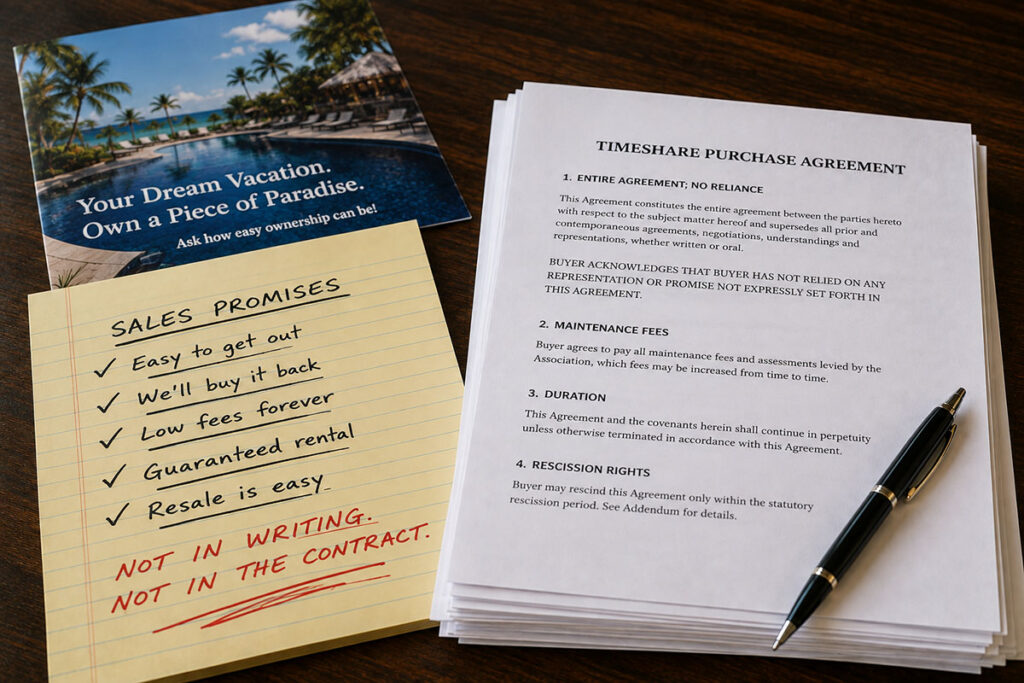
Timeshare Fine Print vs. Sales Promises
Timeshares are often sold through conversation. The contract, however, is where the legal relationship is defined. That gap is significant.
During a sales presentation, buyers may hear about vacation flexibility, rental opportunities, resale value, future upgrades, family benefits, or ways to leave the ownership later. The presentation can last for hours, involve several sales representatives, and produce dozens of verbal statements before a buyer ever reaches the closing documents.
Then comes the contract. Those documents may contain provisions stating that the written agreement represents the entire understanding between the parties and that statements made outside the contract cannot be relied upon. Other sections may address continuing maintenance fees, assessments, dispute procedures, financing, inheritance, transfer restrictions, and a limited statutory cancellation period.
For owners trying to understand how to get out of a timeshare, this is often where the real legal analysis begins: not with what the salesperson promised, but with how those promises compare with the documents the consumer was ultimately asked to sign.
The Sales Presentation and the Contract Serve Very Different Purposes
Timeshare sales presentations are designed to sell the experience. The contract is designed to define the transaction. Those are not necessarily the same thing.
A salesperson may describe a timeshare as flexible. The contract may impose significant restrictions on reservations or exchanges. A buyer may be told that maintenance fees will remain manageable. The governing documents may permit those fees to increase.
A salesperson may discuss rental opportunities. The written agreement may contain no promise of rental income and may restrict how the ownership can be rented.
An owner may even remember being told that the resort will take the timeshare back if circumstances change. Unless that representation appears in an enforceable agreement or developer program, the contract may provide no automatic right to surrender the ownership.
This is why timeshare disputes cannot be evaluated solely by asking, “What were you told?”
The next question is equally important: “What did the documents actually say?”
The Fine Print Is More Than Fine Print
Calling these provisions “fine print” can make them sound secondary. Legally, they may be some of the most important language in the transaction.
Timeshare agreements frequently include multiple documents: purchase agreements, financing documents, deeds, public offering statements, association documents, disclosures, acknowledgments, addenda, and amendments.
Within those documents may be provisions governing:
- the statutory rescission period;
- maintenance fees and special assessments;
- reservation and usage rights;
- financing obligations;
- dispute resolution and arbitration;
- transfer restrictions;
- representations made during the sales presentation;
- the duration of the ownership or membership; and
- procedures for cancellation, surrender, or transfer.
Understanding those provisions is central to timeshare cancellation law, because an owner cannot properly evaluate an exit strategy without first understanding the legal relationship that needs to be resolved.
The Contract May Say You Did Not Rely on the Salesperson
One provision deserves particular attention. Many consumer contracts contain what lawyers generally call integration, merger, or entire-agreement clauses. In basic terms, these provisions state that the written contract represents the parties’ agreement and may limit reliance on statements that do not appear in the documents.
That becomes especially important in a timeshare transaction.
An owner may clearly remember a salesperson making a promise. Yet the contract may contain an acknowledgment stating that no outside promises were relied upon or that the salesperson lacked authority to modify the written agreement.
Finn Law Group has previously discussed this issue in connection with what we have described as the “Salesman’s License to Lie” problem in timeshare contracting. The issue also received national attention when timeshare sales practices were examined by HBO’s Last Week Tonight with John Oliver.
But an integration clause should not automatically be interpreted to mean that anything said during a sales presentation is legally irrelevant. The facts remain important.
Alleged misrepresentations, material omissions, required disclosures, statutory protections, and the circumstances surrounding the transaction may all require separate legal analysis. Contract language is important, but so is the law governing how that contract was obtained.
What Owners Should Look for in Their Timeshare Documents
Owners considering cancellation should resist the temptation to search only for a paragraph labeled “Cancellation.” The important provisions may be scattered throughout several documents.
Rescission Rights
Timeshare purchasers generally receive a statutory period in which they may cancel a new purchase. The length of that period and the procedure for exercising the right depend on applicable law.
When that period is still open, timing can be critical. Once it expires, the legal analysis changes. The question is no longer simply whether the owner wants to cancel. An attorney may need to examine the transaction more broadly.
Representations and Disclaimers
The contract may contain acknowledgments concerning what the purchaser was or was not promised.
These provisions should be compared carefully against the actual sales experience and any written evidence the owner retained, including emails, worksheets, text messages, presentation materials, handwritten notes, or marketing documents.
Maintenance Fees and Assessments
Owners should understand not only what they currently owe, but what authority exists for future charges.
A sales presentation may focus heavily on the initial purchase price while the governing documents establish financial obligations capable of continuing long after the purchase financing has been paid.
Transfer and Surrender Provisions
A timeshare cannot necessarily be returned simply because an owner no longer wants it. Developers may impose conditions on transfers, deed-backs, or surrender programs. Some programs are voluntary and can change over time.
Dispute Resolution
Arbitration provisions, forum-selection clauses, choice-of-law provisions, and other procedural terms can affect how and where a dispute may be pursued. These provisions are another reason owners should understand the agreement before choosing a strategy.
When a Sales Promise Becomes More Than a Disappointment
There is an important legal difference between regretting a purchase and alleging that a purchase resulted from misleading conduct. A timeshare attorney examining a potential case may compare the sales presentation, written agreement, disclosures, financing documents, and governing law to determine whether there are facts that warrant further legal action.
For example, questions may arise when an owner alleges that material information was misstated, omitted, or presented in a way that conflicts with required disclosures. The existence of a signed contract does not eliminate the need to examine those circumstances. Nor does an allegation of misrepresentation automatically invalidate a contract. That is why these matters require case-specific legal analysis rather than a standardized cancellation letter.
How a Timeshare Attorney Reviews the Same Contract Differently
Most consumers read a contract to understand what they bought. A timeshare attorney reads it to understand the legal relationship, the obligations created by the transaction, the applicable law, and whether the facts surrounding the sale raise additional issues.
That review may include questions such as:
Was the statutory rescission right properly disclosed?
Do the written terms conflict with representations the consumer says were made during the sale?
Were required disclosures provided?
What documents were incorporated into the agreement?
What law governs the transaction?
Does the agreement require arbitration?
Is the ownership deeded, points-based, right-to-use, or structured through another form of membership?
Are there financing obligations separate from the underlying timeshare interest?
What happened after the purchase, including upgrades or contract modifications?
Those questions matter because there is no single answer to how to get out of a timeshare. The appropriate strategy depends on the documents, the facts, the developer, the jurisdiction, and the history of the ownership.
Finn Law Group’s J. Andrew Meyer, managing timeshare attorney, has substantial experience evaluating timeshare disputes. Consumers can also review the firm’s broader attorney credentials.
Timeshare Cancellation Companies and the Problem With a Standardized Exit
The complexity of these contracts also explains why owners should be cautious about assuming every timeshare exit service provides the same type of representation. A timeshare cancellation company may offer an exit process. That does not make the company a law firm.
The issue becomes especially important when an owner’s concerns involve alleged misrepresentation, statutory rights, contract interpretation, financing, title, or a potential legal dispute.
A licensed attorney can analyze those issues and provide legal advice within the scope of the representation. A non-lawyer exit company cannot independently practice law simply because its services involve a timeshare contract.
Owners considering outside assistance should understand why hiring a law firm instead of an exit company can matter when the problem extends beyond requesting a voluntary surrender from the developer.
Before You Stop Paying, Know What the Contract Allows
Frustrated owners sometimes conclude that if the resort will not let them leave, they will simply stop paying. That decision can create a new set of problems.
Depending on the ownership, financing, developer, and applicable law, nonpayment may lead to late charges, collection activity, credit reporting, foreclosure, or other consequences.
Stopping payment does not necessarily cancel the underlying ownership. Before taking that step, owners should understand what obligations remain and what consequences the documents permit. A legal strategy should generally begin with understanding the contract, not creating an additional dispute before the existing one has been evaluated.
What to Gather Before Speaking with a Timeshare Attorney
If you believe the sales presentation and contract tell two different stories, preserve both. Start with the complete purchase file rather than a single document. Keep the purchase agreement, deed if applicable, financing documents, public offering materials, disclosures, upgrade agreements, maintenance-fee statements, correspondence with the developer, and anything provided during the sales presentation.
Also write down what you remember while those details are still available. Who made the representation? What exactly was said? Was anyone else present? Was the promise repeated? Did you receive anything in writing that supports it?
Details make a strong case. The stronger the documentary record, the easier it becomes for an attorney to compare what occurred with what the contract and applicable law required.
Frequently Asked Questions
Does the written timeshare contract always override what the salesperson told me?
The written contract is extremely important and may contain provisions limiting reliance on outside statements. That does not mean alleged misrepresentation or omitted information is automatically irrelevant. The contract, sales circumstances, applicable law, and available evidence should be evaluated together.
What if the salesperson promised I could sell or rent my timeshare?
Preserve any documentation supporting the representation. Whether the statement creates a potential legal issue depends on what was said, what the contract and disclosures state, and the law applicable to the transaction.
How do I get out of a timeshare after the rescission period expires?
There is no universal process. Possible approaches depend on the ownership, contract, developer, facts surrounding the sale, account status, and applicable law. A contract review is often the appropriate starting point.
Can I cancel because I did not read all of the fine print?
Failing to read a contract does not ordinarily create an automatic right to cancel it. However, other facts surrounding the transaction may still be legally relevant and should be reviewed separately.
Should I use a timeshare cancellation company?
Before paying any company, determine who will actually handle the matter, whether legal advice is being offered, what services are included, and what happens if the developer refuses to cooperate. If the matter involves legal rights or potential claims, consider speaking with a licensed attorney.
Additional answers to common ownership and cancellation questions are available through Finn Law Group’s timeshare attorney FAQs.
The Contract Is Where the Exit Analysis Begins
The sales presentation may explain why an owner bought the timeshare. The contract helps determine what the owner actually agreed to. When those two stories do not match, the answer is not to ignore one in favor of the other. It is to examine the complete transaction.
For owners trying to determine how to get out of a timeshare, that means reviewing the written agreement, the representations surrounding the sale, the applicable consumer protections, and the ownership history before deciding what to do next.
Disclosure
This article is provided for general informational purposes only and does not constitute legal advice. Timeshare laws, contract provisions, and available remedies vary by jurisdiction and individual circumstances. Past results do not guarantee future outcomes.
About Finn Law Group
Finn Law Group is a timeshare law firm focused on representing consumers in timeshare-related matters. From its Florida headquarters, the firm works with owners confronting complex contracts, disputed sales representations, cancellation concerns, developer disputes, and other legal issues arising from timeshare ownership.
The firm’s practice is built around legal analysis rather than a standardized exit process. Attorneys review the ownership documents, sales history, applicable law, and individual circumstances before advising a client about available options. Where the facts and law support it, that representation may include negotiation, dispute resolution, or litigation.
To learn more about the lawyers behind the firm’s timeshare practice, review Finn Law Group’s attorney credentials.
| Ready to Understand Your Options? Speak with a member of our legal team about your timeshare contract and what steps may be available to you. Call 727-214-0700 |