Why Consumer Protection Matters Beyond Timeshares
Every day, consumers share enormous amounts of personal information with companies. We provide our names, addresses, phone numbers, payment information, browsing habits, and even our physical locations through smartphones and connected devices. Most people assume that this information will be handled responsibly. Unfortunately, that is not always the case.
When companies misuse consumer data or fail to protect sensitive information, federal regulators often step in to investigate and impose penalties. A recent decision by the United States Supreme Court has reinforced the government’s ability to do exactly that, while also preserving important legal protections for businesses accused of wrongdoing.
Although the case involved telecommunications companies, the broader lessons extend to every consumer who relies on federal agencies to protect their privacy and enforce consumer protection laws.
The Case That Reached the Supreme Court
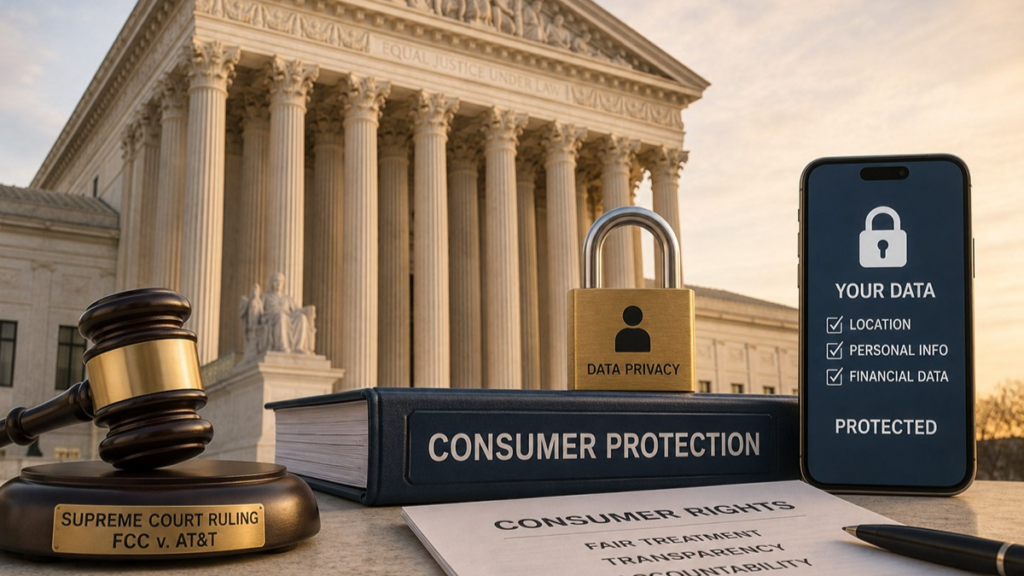
The case, FCC v. AT&T, arose from allegations that major wireless carriers shared customer location information with third parties without proper authorization.
Location data is among the most sensitive information consumers possess. It can reveal where someone lives, works, shops, seeks medical treatment, attends religious services, or spends time with family and friends.
Federal regulators argued that companies handling this type of information have a responsibility to safeguard it and comply with federal privacy laws. As part of its enforcement efforts, the Federal Communications Commission sought significant financial penalties against the companies involved.
The carriers challenged the FCC’s authority, arguing that the agency’s enforcement process violated constitutional protections, including the right to a jury trial. The dispute eventually reached the United States Supreme Court.
Why the Court’s Decision Matters
At its core, the case was about accountability. The Supreme Court was asked to determine whether the FCC could continue using its existing enforcement process to pursue penalties against companies that violate federal regulations.
The Court ultimately ruled in favor of the government.
Importantly, the Court distinguished the FCC’s enforcement process from another recent Supreme Court decision involving the Securities and Exchange Commission. Unlike the penalties examined in that case, FCC forfeiture orders do not immediately force a company to pay. If a company refuses to pay, the government must still bring a lawsuit in federal court and prove its case before collecting any money.
Because businesses retain the ability to challenge the penalties before a federal judge or jury, the Court concluded that the FCC’s process complies with constitutional requirements. While that legal distinction may seem technical, its practical consequences are significant for consumers.
Federal Agencies Retain Important Enforcement Tools
The decision provides clarity for federal agencies that rely on similar enforcement systems to police corporate misconduct.
Agencies responsible for telecommunications, energy markets, consumer protection, and other highly regulated industries often depend on administrative enforcement mechanisms to investigate violations and impose penalties. Without these tools, regulators could be forced to litigate every dispute in federal court from the very beginning. Such a system would be slower, more expensive, and far less efficient.
The Court’s ruling allows agencies to continue using their expertise to investigate wrongdoing while preserving a company’s right to challenge enforcement actions in court. For consumers, this means that federal watchdogs remain equipped to pursue companies that violate laws designed to protect the public.
What the Decision Means for Consumer Privacy
Privacy concerns continue to grow as technology becomes increasingly integrated into everyday life.
Consumers often have little visibility into how their information is collected, stored, shared, or sold. Many people click through lengthy privacy policies without fully understanding how their data may be used.
The FCC has long played an important role in protecting what is known as Customer Proprietary Network Information, or CPNI. These rules are intended to prevent telecommunications companies from improperly using or disclosing sensitive customer information. The Supreme Court’s decision strengthens the FCC’s ability to enforce those protections. For consumers, that means companies handling sensitive personal information continue to face meaningful consequences when they fail to comply with privacy laws.
The ruling also sends a message to the technology and telecommunications sectors that federal oversight remains active, and that regulators retain the authority to investigate and pursue violations.
What This Means for Timeshare Owners and Other Consumers
At first glance, a Supreme Court case involving telecommunications companies may seem unrelated to timeshare ownership. However, the principles behind the decision are highly relevant to consumers in many industries.
Whether the issue involves personal data, financial products, telecommunications services, or timeshare contracts, consumers often face a similar challenge. Large corporations typically possess more information, more resources, and greater bargaining power than the individuals they serve.
That imbalance is one reason consumer protection laws exist.
The timeshare industry provides a useful example. Most consumers attend a sales presentation expecting to receive complete and accurate information before making a significant financial commitment. They rely on the representations made by sales professionals when deciding whether to purchase a product that may affect their finances for years or even decades.
When disputes arise later, consumers often begin asking difficult questions.
- Were all of the costs fully disclosed?
- Did the written contract accurately reflect the promises made during the sales presentation?
- Were important limitations, fees, or restrictions adequately explained?
These concerns are not unique to timeshare ownership. They are the same types of issues that consumer protection laws seek to address across many industries.
The Supreme Court’s decision reinforces an important principle. Regulatory agencies must continue to have meaningful enforcement tools available when companies violate laws designed to protect consumers.
The Continuing Importance of Consumer Protection
As technology evolves and consumer transactions become more complex, regulatory oversight will continue to play an important role in protecting the public. Most consumers do not have the resources to challenge large corporations on their own. Federal agencies often serve as the first line of defense when privacy violations, deceptive practices, or other forms of misconduct occur.
The Supreme Court’s decision in FCC v. AT&T helps preserve those enforcement tools. For consumers, the ruling offers reassurance that federal regulators remain capable of pursuing companies that misuse sensitive information or violate laws designed to protect the public.
For timeshare owners and other consumers, the case serves as a reminder that transparency, accountability, and fair dealing remain central principles of consumer protection. Whether the issue involves personal data, telecommunications services, financial products, or vacation ownership contracts, consumers benefit when businesses understand that they can be held accountable for their actions.
_______________________________________________________
Disclosure: This blog is for information purposes only and is not intended as legal advice. Always seek competent counsel for specific assistance in dealing with timeshare resales.
Led by Timeshare attorneys J. Andrew Meyer and Michael D. Finn with over 75 years of combined legal experience. The Finn Law Group is a consumer protection firm that specializes in Timeshare Law. For a free consultation, please contact our office at 727-214-0700 or email us at contact@finnlawgroup.com or follow us on X.