
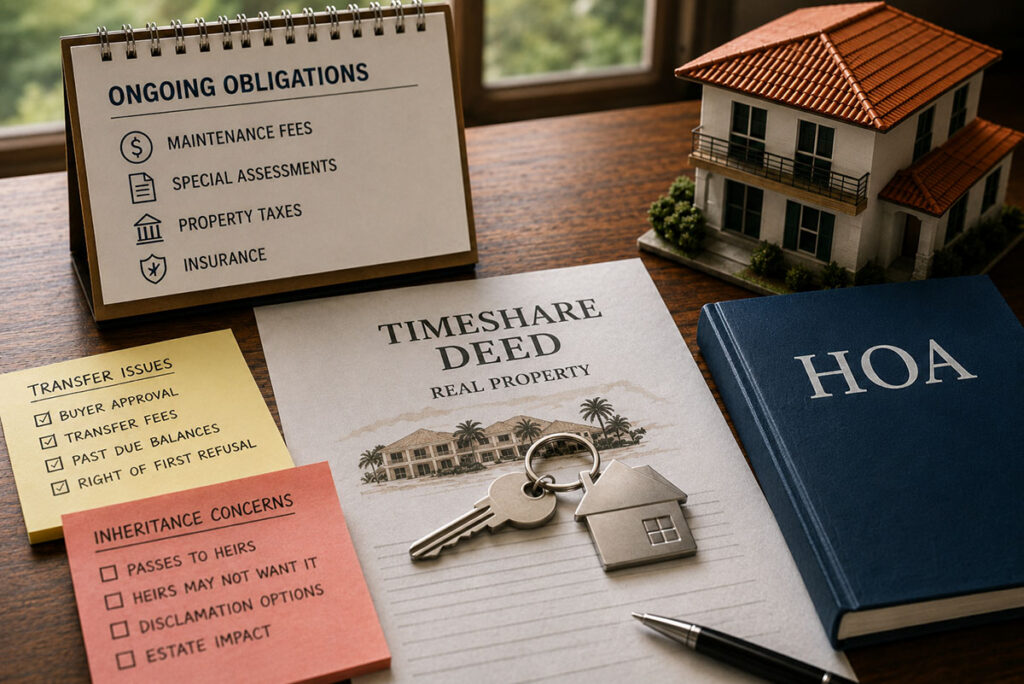
What Owners Misunderstand About Deeded Timeshares
The word “deeded” can give timeshare buyers a powerful impression. If an ownership comes with a recorded deed, it can sound more permanent, more valuable, and perhaps more similar to traditional real estate than other forms of vacation ownership.
Legally, a deed does matter. But it does not necessarily mean what many owners assume it means. A deeded timeshare generally represents an interest in real property. At the same time, that interest may be subject to resort governing documents, use restrictions, recurring maintenance fees, special assessments, transfer requirements, and other obligations that can continue long after an owner stops vacationing at the resort.
That is where many owners encounter problems. Owning real property does not necessarily mean owning an asset that is easy to sell, easy to control, or easy to leave behind. Understanding what the deed actually provides and what obligations come with it, is an important part of evaluating a timeshare ownership.
What Does a Timeshare Deed Actually Give You?
A deeded timeshare generally gives the owner a recorded interest in real property. Depending on the ownership structure, that could involve a fractional interest in a particular unit or an undivided interest associated with a larger timeshare property.
That is different from some right-to-use arrangements or vacation memberships, where the consumer receives contractual use rights rather than a deeded property interest. But holding a deed should not be confused with having the same control someone might expect from owning a traditional home or condominium.
Timeshare ownership is usually governed by layers of additional documents. These may include declarations, association rules, reservation procedures, use restrictions, exchange requirements, and provisions governing assessments and transfers. The deed establishes an ownership interest. The surrounding documents help determine what an owner can actually do with it.
A Deed Does Not Guarantee Resale Value
This is one of the most important misconceptions surrounding deeded timeshares. Consumers often associate real estate ownership with equity. A homeowner may purchase property expecting that it could appreciate over time and eventually be sold to another buyer.
A timeshare can operate very differently. Having a recorded deed does not guarantee that there will be meaningful demand for the ownership on the secondary market. The price originally paid to a developer may reflect sales commissions, marketing expenses, financing, resort amenities, and other costs that a resale buyer may have little reason to pay.
As a result, the fact that a timeshare is deeded should not be viewed as proof that it will retain its original purchase value. For an owner trying to leave a timeshare years later, that can be a difficult realization: the deed may remain legally enforceable even when the market places very little value on the ownership.
Stopping Vacations Does Not End Deeded Ownership
Another common misunderstanding involves use. An owner may stop visiting the resort for several years and reasonably wonder why maintenance bills continue to arrive. The answer is that use and ownership are separate issues.
The obligation is generally connected to the ownership interest—not the number of vacations taken. As long as the deed remains in the owner’s name, applicable maintenance fees and assessments may continue according to the governing documents. Simply deciding not to make another reservation does not transfer the property back to the developer or terminate the ownership. The same concern applies to stopping payment.
Nonpayment generally does not create a voluntary cancellation. Instead, it can result in late fees, collection activity, possible credit consequences, or foreclosure proceedings depending on the circumstances. Before withholding payments as an exit strategy, owners should understand the legal and financial consequences associated with their particular ownership.
Maintenance Fees Can Outlast the Reason You Bought the Timeshare
Timeshare sales presentations naturally focus on vacations. The buyer sees the resort, accommodations, pools, beaches, destinations, and experiences that ownership is supposed to provide. The recurring financial obligation may seem secondary when compared with the immediate appeal of the vacation itself.
Years later, the balance can look very different. Children grow up. Travel habits change. A spouse may pass away. Retirement may change the household budget. The resort may no longer be a preferred destination. Yet maintenance fees can continue because the ownership continues.
Special assessments can create additional obligations depending on the resort and its governing documents. This is one reason owners should evaluate a deeded timeshare as a long-term legal and financial commitment rather than simply as a prepaid vacation plan.
Deeded Timeshares and Inheritance Require Careful Planning
The permanent nature of a deed also creates questions for families.
Because a deeded timeshare is an ownership interest, it can become part of an owner’s estate. What happens after death depends on factors that can include how title is held, estate documents, applicable state law, and actions taken during estate administration.
Owners should not simply assume that their children will want the timeshare—or that heirs will automatically become personally responsible merely because they are beneficiaries.
In some circumstances, an heir may be able to disclaim an inherited interest. However, disclaimers can involve specific legal requirements and deadlines, and the outcome depends on the particular estate and applicable law.
For an owner who already knows that no one in the family wants the timeshare, addressing the issue during estate planning may be preferable to leaving surviving family members to sort it out later.
Selling a Deeded Timeshare Is Not the Same as Selling a Home
The word “deed” can also lead owners to assume they can simply list the timeshare and sell it like other real estate. In theory, a deeded interest may be transferable. In practice, several issues can make that considerably more difficult.
There must first be someone willing to accept the ownership and its future financial obligations. The resort may also impose transfer procedures, documentation requirements, fees, or other conditions permitted by the governing documents.
Past-due maintenance fees, outstanding financing, liens, or assessments can further complicate a transfer. Owners should also be particularly careful with unsolicited resale offers. A company claiming that it already has a buyer—or asking for a substantial upfront payment to complete a supposed sale—should be independently investigated before money changes hands.
A deed can be transferred. That does not mean there is necessarily a healthy market waiting to buy it.
What About Developer Deed-Back Programs?
Some timeshare developers and associations have programs that may allow qualifying owners to surrender an ownership. When a legitimate program is available and the owner qualifies, it may be worth considering.
But deed-back programs should not be confused with an unconditional right to return a timeshare. Eligibility requirements can vary. A developer may require the ownership to be paid in full, maintenance fees to be current, or other conditions to be satisfied. Programs can also change, close, or exclude certain ownership types.
Owners should obtain the terms in writing and understand exactly what will happen to the deed and outstanding financial obligations. Most importantly, do not assume a telephone conversation has ended the ownership.
A timeshare should not be treated as resolved until the necessary documents have been completed and the owner has reliable documentation showing what happened to the legal interest.
When the Problem Goes Back to the Original Sale
Sometimes the issue is not simply that an owner no longer wants the timeshare. The owner may believe the deeded ownership was sold based on representations that were materially different from the documents ultimately signed.
For example, questions can arise about statements concerning resale value, rental opportunities, availability, future costs, inheritance, or the ability to surrender the ownership later. Those situations require a different analysis.
An attorney reviewing the matter may need to compare what happened during the sales presentation with the purchase agreement, deed, disclosures, financing documents, later upgrades, and applicable law. The existence of a deed does not prevent the circumstances surrounding the transaction from being examined.
Finn Law Group’s overview of Timeshare Cancellation Law provides additional information about how timeshare contracts and potential cancellation issues may be evaluated.
Why the Entire Ownership History Matters
Many long-term timeshare owners no longer have the same ownership they originally purchased. They may have upgraded. A fixed week may have been converted into points. Additional interests may have been purchased. Financing may have been replaced. A developer acquisition may have changed the resort system or membership structure.
That history is an important factor. Looking only at the most recent deed can miss agreements signed years earlier that help explain how the current ownership developed.
For this reason, Finn Law Group encourages owners seeking legal review to gather as much documentation as reasonably available, including original purchase agreements, deeds, financing documents, upgrade paperwork, maintenance statements, correspondence, and developer communications. A timeshare problem is rarely solved by looking at one page in isolation.
Why a Timeshare Attorney Approaches the Deed Differently
Owners searching online for help may encounter timeshare exit companies promising to make the timeshare disappear. But when the issue involves a deed, contractual rights, alleged sales misrepresentations, disputed obligations, collections, or a contested transfer, the owner may be dealing with legal questions. That is where the type of professional handling of the matter becomes important.
A licensed attorney can examine the deed together with the contract, governing documents, sales history, and applicable law. If a dispute develops, an attorney can provide legal advice and pursue available legal remedies when appropriate. An exit company is not a substitute for licensed legal counsel.
Finn Law Group discusses this issue further in why hiring a law firm instead of an exit company.
Frequently Asked Questions
Does having a deed mean my timeshare has real estate value?
Not necessarily. A deed establishes a property interest, but it does not guarantee market demand or resale value. A deeded timeshare can remain a legally enforceable ownership even when its secondary-market value is limited.
Can I just stop paying maintenance fees if I no longer use my timeshare?
Stopping payment generally does not cancel the deed. Depending on the ownership and governing documents, nonpayment may result in late fees, collection activity, credit consequences, or foreclosure. Owners should understand those risks before deciding how to proceed.
Can I simply give my deed back to the resort?
Only if the developer or association agrees to accept it through an appropriate process. Some resorts offer surrender or deed-back programs, but eligibility and terms vary. A unilateral request to return the property does not necessarily end ownership.
Will my children automatically inherit my deeded timeshare?
Not necessarily. What happens depends on title, estate planning documents, applicable law, and estate administration. Potential heirs may also have legal options concerning an unwanted inheritance. An estate or probate attorney can advise on the specific inheritance issues involved.
What if the salesperson misrepresented what my deed meant?
Representations made during a timeshare sale can be relevant to a legal review, particularly when they concern material aspects of the ownership. An attorney can compare the sales circumstances with the written documents and applicable law to determine whether legal issues may exist.
Is a deeded timeshare harder to cancel than a right-to-use membership?
The legal issues are different because a deeded timeshare involves a real property interest, while a right-to-use arrangement is generally contractual. The appropriate approach depends on the ownership documents, developer, jurisdiction, and circumstances surrounding the transaction.
More information about common timeshare legal questions is available through Finn Law Group’s Timeshare Attorney FAQs.
A Deed Should Tell You What You Own—Not What It Is Worth to You
The most important lesson about a deeded timeshare is straightforward: legal ownership and practical value are not the same thing.
A deed may establish a legitimate real property interest while also carrying recurring costs, limited resale demand, transfer requirements, and long-term obligations that the owner did not fully appreciate when purchasing.
Those obligations should not be ignored. But owners also should not assume they have no options simply because a deed exists.
If your deeded timeshare has become difficult to use, afford, transfer, or leave to your family, understanding the documents is the first step. Call 727-214-0700 or contact Finn Law Group for a free consultation to discuss your ownership.
Disclosure
This article is provided for general informational and educational purposes only and does not constitute legal, real estate, estate planning, tax, or financial advice. Timeshare ownership structures, deed requirements, maintenance obligations, transfer procedures, inheritance rules, cancellation options, and available legal remedies vary by jurisdiction and individual circumstances. No particular outcome is guaranteed, and past results do not guarantee future outcomes. Reading this article or contacting Finn Law Group does not create an attorney-client relationship. Consumers should consult an appropriately licensed attorney regarding their specific circumstances before making decisions concerning a deeded timeshare.
About Finn Law Group
Finn Law Group is a timeshare law firm and consumer protection practice headquartered in St. Petersburg, Florida. The firm represents timeshare owners in legal and contractual matters involving vacation ownership, including cancellation, disputed sales representations, financing, maintenance obligations, developer disputes, and problems involving timeshare exit and resale companies.
Finn Law Group evaluates timeshare matters individually. Its attorneys review the documents and history behind an ownership to understand what the consumer purchased, how the ownership may have changed, what obligations remain, and what legal options may be available.
If you are concerned about the obligations attached to a deeded timeshare, call 727-214-0700 or schedule a free consultation with Finn Law Group.
| Not Sure What Your Deeded Timeshare Really Obligates You To? Our legal team can review your deed and explain your options in plain terms. Call 727-214-0700 or schedule a free consultation with Finn Law Group. |