

Timeshare Points vs Weeks: Why the Ownership Model Matters
The timeshare industry has changed considerably over the years. Traditional fixed-week ownership once dominated the market. Today, many developers sell points, vacation clubs, trusts, and other membership-based programs designed to offer owners greater flexibility.
But flexibility in how a timeshare is used should not be confused with flexibility in how the ownership or contractual obligation can be ended.
That becomes particularly important when an owner begins considering cancellation. A deeded week and a points-based membership may both be marketed as vacation ownership, but the legal documents behind them can be very different. Those documents determine what an owner actually purchased, what financial obligations continue, what transfer restrictions apply, and what may be required to bring the relationship to an end.
At Finn Law Group, we believe the starting point should be the ownership documents themselves, not simply the name of the vacation program or the number of points shown on an account statement.
Timeshare Weeks: The Traditional Ownership Model
For decades, timeshares were commonly sold as weeks. An owner purchased the right to occupy a particular resort for a defined period each year.
A fixed week generally provides use during the same week each year. A floating week may allow an owner to choose from dates within a particular season or reservation period, subject to availability and the resort’s rules.
Many traditional week-based timeshares were also sold as deeded interests in real property. When that occurs, the owner’s interest may be recorded in public land records and governed not only by the purchase agreement, but also by the deed, declarations, association documents, and applicable real property and timeshare laws.
That is important because deciding not to vacation at the resort does not eliminate a recorded ownership interest. An owner may stop using the week entirely and still remain responsible for timeshare maintenance fees, assessments, taxes where applicable, and other obligations associated with the ownership.
Owning a Week Does Not Necessarily Mean Owning a Particular Vacation
There is another issue timeshare owners sometimes overlook. A deed may establish an ownership interest, but the owner’s practical ability to use the resort can still depend upon reservation rules, exchange programs, season classifications, availability, association requirements, and other governing documents.
In other words, ownership and use are related, but they are not necessarily the same thing. That becomes increasingly important when owners discover that the vacation experience they expected has changed while the financial obligations have continued.
Points-Based Timeshares Changed the Product, Not the Need to Read the Contract
Points programs were introduced in part to provide greater flexibility. Instead of purchasing one particular vacation week, an owner may receive an annual allocation of points that can potentially be used for different resorts, travel dates, accommodations, or experiences within a developer’s network.
That flexibility can be attractive. It can also make the legal structure considerably more difficult for consumers to understand. A points program might involve a club membership, a right-to-use agreement, a beneficial interest in a trust, a deeded interest converted into points, or another ownership structure created by the developer.
That is why saying, “I own timeshare points,” does not necessarily tell an attorney what the consumer legally owns. The answer is in the documents.
Points vs. Weeks: What Owners Should Understand
The differences are easier to see when the two models are compared side by side.
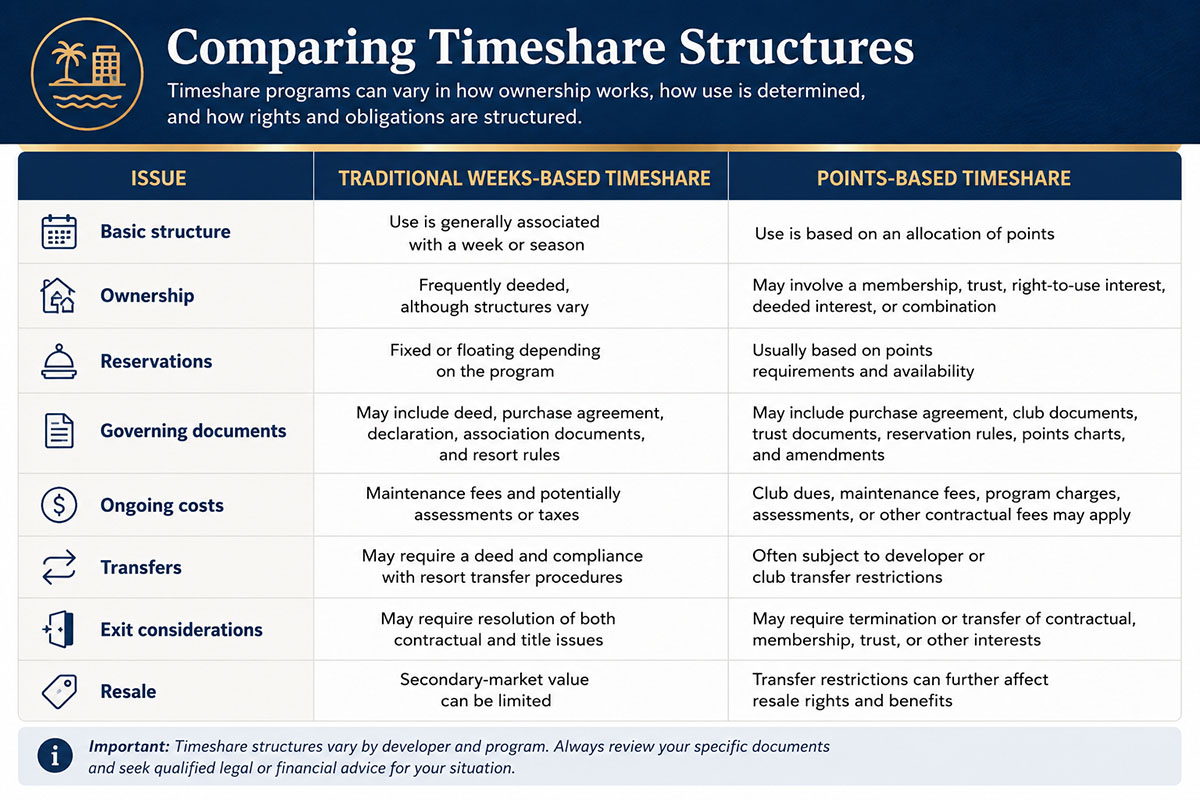
The important point is that neither model should be assumed to be easier to exit simply because of how it is marketed.
Why Ownership Structure Matters When an Owner Wants Out
When owners ask how to cancel a timeshare, one of the first questions should be: What exactly do you own?
For a deeded week, the analysis may involve recorded title, the purchase agreement, association documents, transfer provisions, financing, and the circumstances surrounding the original sale.
With a points program, the analysis may involve several layers of agreements. An attorney may need to determine whether the points represent a membership, a trust interest, an underlying deed, or another contractual arrangement.
This is one reason timeshare cancellation law requires more than sending a form letter to a developer. The ownership structure is part of the legal analysis.
A Points Program Can Change Over Time
Points owners should also understand that the program they purchased may not remain exactly as it was presented. Reservation procedures can change. Points requirements can change. Program rules can be amended. Resorts can enter or leave networks. Fees can increase. Exchange benefits may also depend on separate programs or eligibility requirements. An owner therefore needs to look beyond the number of points purchased and understand the documents governing those points.
The central question is not simply “How many points do I own?” It is “What legal rights and obligations did I agree to when I purchased them?”
Converting a Week to Points Deserves Particular Attention
Existing owners are frequently invited back to a resort for an “owner update” and presented with an opportunity to convert, upgrade, or move from a traditional week into a points program.
Those transactions deserve careful review. A conversion may involve signing an entirely new purchase agreement, financing additional ownership, modifying existing rights, joining a new club, or changing how an existing deed interacts with a vacation program.
Timeshare owners should not assume that converting to points eliminates the original ownership or makes a future exit easier. Depending on the documents, the transaction may actually add another layer of contractual obligations.
If an owner was told that converting was necessary, would improve resale value, would provide an easier future exit, or would solve problems with an existing ownership, those representations should be compared carefully against the written agreement.
The Resale Problem Exists in Both Models
Another misconception is that one ownership structure automatically creates greater resale value. Timeshare resale markets can be difficult regardless of whether the product involves weeks or points. Developer pricing at the sales table should not be treated as evidence of what an ownership interest will command on the secondary market.
Points programs can present an additional complication because certain benefits available to an original purchaser may not necessarily transfer to a secondary-market buyer. Likewise, a deeded week may technically be transferable while having little practical demand in the resale market.
For an owner considering an exit, the ability to transfer something legally and the ability to find someone willing to assume it economically are two separate questions.
Why Owners Should Be Careful With Timeshare Exit Companies
The complexity of modern timeshare ownership has also created an opportunity for a secondary industry of timeshare exit companies. Owners should understand what they are purchasing before paying one.
An exit company may market a standardized “exit” process without first determining whether the consumer owns a deed, points, a trust interest, a club membership, or some combination of these. That can be a serious problem because these ownership structures do not necessarily require the same legal response.
A licensed attorney can review the underlying documents, evaluate the circumstances surrounding the sale, identify potential legal issues, communicate on behalf of a client within the scope of the representation, and pursue legal remedies when the facts and law support doing so.
Timeshare exit companies themselves cannot practice law unless appropriately licensed attorneys are actually providing those legal services directly to the individual owner and not just as general counsel. Owners considering outside assistance should understand why hiring a law firm instead of an exit company can matter before paying substantial upfront fees.
The Contract is More Than the Label
One of the recurring problems in timeshare ownership is the industry’s vocabulary.
“Vacation ownership.”
“Points.”
“Membership.”
“Club.”
“Vacation currency.”
“Beneficial interest.”
Those terms may describe how a product is marketed or used, but they do not necessarily explain the legal obligation underneath it.
Two owners may both say they own “points” while holding very different legal interests. Likewise, two owners at the same resort may have different contracts because one purchased a deeded week years ago, and another later entered a points program.
That is why a legal analysis begins with the documents. The purchase agreement, deed if one exists, financing documents, amendments, upgrades, conversion agreements, club rules, and relevant sales history can collectively provide a much clearer picture than the marketing name attached to the product.
Frequently Asked Questions
Is a points-based timeshare considered real property?
Sometimes, but not always. Points programs can be structured in several ways, including memberships, trusts, right-to-use arrangements, or systems connected to deeded interests. The underlying documents must be reviewed before determining what type of interest an owner holds.
Is a deeded week easier to cancel than points?
Not necessarily. A deeded week can involve title and transfer requirements, while points programs may involve complex membership, trust, or contractual provisions. Neither structure should automatically be considered easier to resolve.
Does converting my week to points cancel the original deed?
Do not assume that it does. The effect of a conversion depends on the documents signed during the transaction. Owners should determine precisely what happened to the original interest and what new obligations were created.
Can I stop paying because I no longer use my points?
Nonuse generally does not terminate ownership or contractual payment obligations. Stopping payment without understanding the agreement can result in collections, credit issues, or other consequences.
Why do my points seem to buy less vacation than they once did?
Points programs are governed by program rules, reservation requirements, availability, and points schedules that may change according to the governing documents. Owners concerned about changes should compare current program requirements with their original agreements and subsequent amendments.
Can a timeshare attorney handle both points and deeded weeks?
Yes. The legal analysis simply begins differently depending on the ownership. A timeshare attorney can review the applicable contracts and ownership documents and determine what legal options may exist.
Additional questions about timeshare ownership and cancellation are addressed in our timeshare attorney FAQs.
Before You Decide How to Exit, Determine What You Own
Points and weeks may provide different vacation experiences, but the more important issue for an owner considering cancellation is the legal structure underneath them.
A deed does not disappear because the week is no longer used. A points obligation does not necessarily end because an owner stops making reservations. And converting from one system to another does not automatically eliminate the obligations that came before it.
The documents tell the story.
If your timeshare has changed through upgrades, conversions, points purchases, or new membership agreements, understanding that history can be an important first step toward determining what comes next.
Call 727-214-0700 or contact Finn Law Group for a free consultation to discuss your ownership with a timeshare attorney.
About Finn Law Group
Finn Law Group is a St. Petersburg, Florida-based law firm focused on timeshare law and consumer protection. Founded by attorney Michael D. Finn, the firm represents timeshare owners in matters involving contracts, sales practices, ownership disputes, cancellation, and other issues arising from vacation ownership.
The firm’s attorneys evaluate each matter based on the client’s documents, ownership history, applicable law, and individual circumstances rather than relying on a standardized exit process. Finn Law Group’s timeshare attorneys have experience in negotiation and litigation involving the timeshare industry. Learn more about the firm’s lawyers through our attorney credentials page.
Disclosure
This article is provided for general informational and educational purposes only and does not constitute legal advice. Timeshare contracts, ownership structures, rescission rights, transfer requirements, and available remedies vary by jurisdiction and individual circumstances. Past results do not guarantee or predict future outcomes. Consult with a licensed attorney regarding your specific circumstances.