
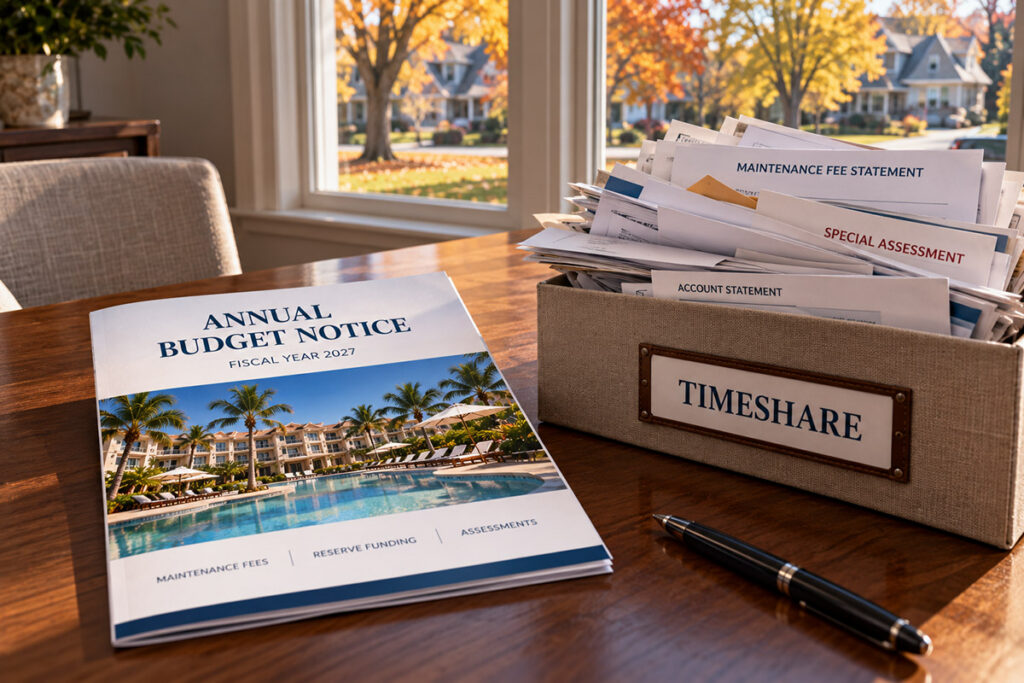
Timeshare Annual Budget Notices Explained: What Owners Need to Know
For many timeshare owners, the annual budget notice is one of those documents that arrives, gets a quick glance, and ends up in a file with the rest of the ownership paperwork.
Until the number changes enough to get their attention.
Perhaps the annual maintenance fee has increased again. A reserve contribution is noticeably larger. A new expense appears in the budget. Or there is a special assessment that was not part of the owner’s expectations when the timeshare was purchased.
An increase does not necessarily mean something is wrong. Resorts have operating expenses, properties age, insurance costs change, and major repairs eventually become necessary. But an owner who is expected to contribute to those expenses should understand what is being charged, why it changed, and what the governing documents say about how those costs are determined.
The annual budget notice can provide part of that answer. More importantly, when viewed alongside several years of prior budgets, maintenance-fee statements, assessments, and the original ownership documents, it can help an owner understand how the financial obligations of the timeshare have changed over time. The original draft correctly identifies operating expenses, reserves, assessments, and owner disclosure rights as the central issues behind these notices.
What Is a Timeshare Annual Budget Notice?
A timeshare annual budget generally describes the anticipated costs of operating the resort, association, club, or ownership program for the coming year and how those costs will be allocated.
The exact document will differ depending on the property and ownership structure. A deeded resort with an owners’ association may present its budget differently from a points-based vacation club or trust program. The governing documents and applicable state law may also establish particular budgeting, notice, voting, or record-access requirements.
Owners commonly see expenses associated with housekeeping, staffing, utilities, landscaping, insurance, security, management, property maintenance, taxes, amenities, and administrative costs. There may also be contributions to reserve accounts intended to address larger capital expenses that are not part of ordinary day-to-day operations.
The important point is that the budget is not simply an accounting document. For the owner, it can help explain why the cost of continuing to own the timeshare is changing.
Maintenance Fees Are Tied to an Operating Budget
Maintenance fees are often discussed as though they are simply an annual charge attached to the timeshare. In practice, those fees generally relate to the cost of operating and maintaining the property or program.
That can include expenses owners readily understand, such as housekeeping, utilities, landscaping, insurance, staffing, and general property maintenance. The difficulty often comes when those costs change substantially from one year to the next.
A resort may experience higher insurance premiums. Labor expenses may increase. Utilities may cost more. An aging property may require more maintenance. Management expenses can change, and major projects may require increased reserve funding.
None of those circumstances automatically makes an increase improper.
But an owner who sees the annual obligation steadily rising should begin paying closer attention to the budget rather than looking only at the total amount due.
The total tells you what you owe. The budget may help explain why.
Reserve Funding Deserves a Closer Look
Reserve accounts are intended to prepare for significant expenses that do not occur every year. A roof does not need replacement annually. Neither does a swimming pool, elevator system, parking area, HVAC system, or major building component. But eventually those expenses arrive.
A well-funded reserve can allow an association to plan for those projects over time rather than attempting to collect the entire amount from owners when a major repair becomes unavoidable.
That makes the reserve contribution an important part of an annual budget notice.
If reserve funding increases, owners may want to understand whether a major project is anticipated, whether the property is aging, or whether the association is attempting to strengthen reserves for future expenses.
Conversely, consistently low reserve funding can raise a different question: What happens when a large capital expense eventually arrives?
The answer may be a special assessment.
A Special Assessment Is Different From the Regular Annual Fee
A special assessment is generally a charge imposed outside the ordinary annual maintenance fee to address a particular financial need.
The circumstances can vary considerably. A resort may face storm damage, an insurance issue, an unexpected structural repair, a major mechanical failure, or a renovation that existing reserves cannot fully cover. The original draft identifies these larger or unexpected expenses as common reasons an assessment may appear.
Owners should not assume that a special assessment is improper simply because it is large or unexpected.
Instead, look at the documents.
What does the assessment notice say? What expense is being funded? What authority under the governing documents permits the assessment? Was a board or membership action required? Were applicable notice procedures followed? Is supporting financial information available?
Those questions are more useful than assuming that an unexpected bill itself establishes wrongdoing.
At the same time, an assessment can materially change the economics of ownership. An owner who was already questioning whether the timeshare remained affordable may view an additional assessment very differently from an owner who continues to use and value the property every year.
One Year’s Budget Rarely Tells the Whole Story
If an annual budget notice concerns you, compare it with prior years. Looking at several years together can reveal far more than looking at a single statement.
Has insurance become a much larger percentage of the budget? Are reserve contributions increasing? Have administrative or management expenses changed significantly? Has the property experienced several assessments? How has the owner’s total annual obligation changed?
The original draft notes that owners commonly become concerned about recurring fee increases, broad budget categories, limited year-to-year context, and assessments appearing outside the regular annual charges. Those concerns do not necessarily establish a legal problem. They do, however, give the owner a reason to ask better questions.
A five-year history can be particularly useful because it moves the discussion away from “my fees went up again” and toward something more concrete:
How has the financial burden of this ownership actually changed?
Go Back to the Governing Documents
When an owner questions an annual budget, the purchase agreement may not contain every answer.
Depending on the timeshare, relevant provisions may instead appear in the declaration, bylaws, association documents, trust documents, club rules, public offering statement, or other governing materials.
Those documents may explain how annual expenses are allocated, how budgets are adopted, what authority exists to levy assessments, what notices must be provided, and what rights owners have to inspect certain association records.
The rules vary by ownership and jurisdiction. The original draft correctly notes that disclosure and record-access rights depend on state law and the governing documents for the particular property.
This is why a generalized answer from the internet can only go so far.
The question is not simply whether resorts are “allowed to raise fees.”
The better question is:
What authority applies to this resort, this ownership, this budget, and this particular charge?
Ask for More Information When the Numbers Are Not Clear
An owner does not have to understand every accounting term to ask a reasonable question about a budget. If a line item increases substantially, ask what changed. If a category is broad, ask whether additional information is available. If a special assessment is imposed, request the notice and supporting documentation explaining the project or expense.
Keep the request professional and in writing.
There is a practical reason for that. Written correspondence creates a record of what the owner asked and how the association or developer responded. The response may resolve the concern.
It may explain that insurance premiums increased substantially, that a major repair is scheduled, or that reserve funding was adjusted following an engineering or financial review.
If the response does not answer the question, the written record can become useful if the owner later seeks professional legal advice.
Does Your Annual Timeshare Budget No Longer Make Sense?
A higher maintenance fee or special assessment does not automatically mean something improper occurred. But if the numbers have changed substantially, the governing documents and budget history may help explain why.
Finn Law Group can review the ownership documents and circumstances to determine whether the concern is primarily financial, contractual, or potentially legal.
Call 727-214-0700 or schedule a free consultation.
Rising Fees Do Not Automatically Create a Right to Cancel
This is an important point for owners who begin considering an exit after receiving another increase. A maintenance fee increase, by itself, does not necessarily give an owner the right to cancel a timeshare.
The same is generally true of a special assessment. Whether a particular charge is authorized depends on the governing documents, applicable law, and circumstances under which it was adopted.
An owner may reasonably decide that the timeshare has become too expensive for the value received. That is an important financial decision, but it is not necessarily the same as having legal grounds to terminate the ownership. This is where the analysis needs to become more precise.
Perhaps the owner simply wants to leave because annual costs have become burdensome. In that situation, it may make sense to determine whether the developer offers a voluntary surrender or deed-back program.
A different question arises when the owner believes the fees conflict with specific contractual terms, an assessment was imposed contrary to governing procedures, or important representations about the ownership’s financial obligations were made during the sale. Those concerns may warrant legal review.
Look at What You Were Told About Future Costs
Timeshare purchases often involve discussions about affordability. A buyer may have asked how much annual fees could increase. A salesperson may have discussed maintenance expenses, assessments, or how the cost of ownership compared with future hotel stays.
Years later, an owner may remember those conversations very differently from what appears in the governing documents. That does not automatically create a claim.
But if future costs were an important part of the purchase decision, preserve whatever documentation remains from the transaction. That can include sales materials, worksheets, emails, written projections, disclosure documents, and notes.
Then compare those materials with the actual fee history. The legal significance of a disputed representation depends on the specific facts, documents, applicable law, and evidence. An attorney reviewing the issue needs more than the fact that today’s fee is higher than the original fee.
The question is what was represented, what was disclosed, what the written documents provide, and what actually occurred.
Do Not Confuse a Budget Concern with an Exit Strategy
A frustrating budget notice can quickly send an owner online searching for ways to get out of a timeshare. That is understandable, but the two issues should initially be separated.
First determine what the budget means and whether the charges appear to follow the ownership documents and applicable procedures. Then decide whether the timeshare still makes financial sense for you.
If the answer is no, determine what legitimate exit options are available. The developer may offer a voluntary surrender program. A resale or transfer may be possible for some ownerships. Other circumstances may justify review under timeshare cancellation law.
The key is not to let frustration over one bill lead immediately to another expensive decision.
Understand the ownership before deciding how to leave it.
What to Preserve When Annual Costs Become a Concern
Owners do not need to create an elaborate financial audit. Start by keeping the annual budget notices and maintenance fee statements. If you have several years available, organize them chronologically. Keep special assessment notices separately. Preserve any letters or emails explaining significant increases, planned projects, reserve funding, or changes to the resort.
Then add the governing documents and original purchase materials. If you have upgraded or converted the ownership over the years, include those documents as well. A later transaction may have changed the ownership structure or financial obligations.
This type of file gives an attorney something far more useful than a single current-year bill. It provides a history.
When an Annual Budget Becomes a Legal Question
Most budget increases will remain financial or association-management issues rather than legal disputes. But there are circumstances where an attorney may need to look more closely.
An owner may question whether an assessment was authorized under the governing documents. There may be a dispute about required notice or approval procedures. The owner may believe a specific contractual provision is inconsistent with what is now being charged. Or the fee history may become relevant to broader concerns about how the ownership was originally sold or later upgraded. At that point, a licensed attorney can review the budget alongside the purchase documents, governing instruments, sales history, and applicable law.
The objective is not to turn every fee increase into litigation.
It is to determine whether the documents reveal a legal issue and, if so, what response may be appropriate.
Frequently Asked Questions
Can my timeshare maintenance fees increase every year?
Maintenance fees can change as operating expenses, insurance, reserves, repairs, and other costs change. Whether a particular increase is authorized and how it must be adopted depends on the governing documents and applicable law. A fee increase alone does not establish improper conduct.
What is the difference between a maintenance fee and a special assessment?
Maintenance fees are generally recurring charges associated with operating and maintaining the property or program. A special assessment is an additional charge that may be imposed for a particular expense or financial need outside the ordinary annual budget. The authority and procedures for assessments depend on the ownership documents and applicable law.
Can I ask to see more detailed financial information?
Potential owner rights to inspect association records or obtain supporting financial information depend on applicable law and the governing documents. If a budget category is unclear, owners can begin by requesting additional information from the association or developer in writing.
Does a special assessment give me the right to cancel my timeshare?
Not automatically. An assessment may be authorized under the governing documents. If you believe the assessment was improperly imposed or conflicts with contractual or statutory requirements, an attorney can review the circumstances.
What if my maintenance fees are much higher than when I purchased?
Compare the current fee with prior statements and review the governing documents. If you also have concerns about representations made during the sale concerning future costs, preserve any sales materials or other evidence that may help establish what was represented.
Should I stop paying fees while I dispute the budget?
Do not assume that disputing a fee suspends the obligation to pay it. Nonpayment can potentially lead to late charges, collection activity, credit consequences, foreclosure, or other issues depending on the ownership and circumstances. Understand your legal position before intentionally becoming delinquent.
What if the fees have simply made the timeshare too expensive?
That does not necessarily create a legal right to cancel, but it may be a reason to explore legitimate exit options. Start by asking the developer whether a voluntary surrender or owner-relief program is available. If the ownership history raises legal concerns, consider having the documents reviewed by an attorney.
Additional questions about timeshare ownership and legal representation are addressed in Finn Law Group’s timeshare attorney FAQs.
The Budget Notice Is More Than a Bill
For an owner who has held a timeshare for many years, the annual budget notice can become easy to ignore. But it can also provide an important record of how the financial side of the ownership is changing.
Read it. Compare it with prior years. Look at reserve funding. Pay attention to assessments. Ask questions when a category changes substantially or does not make sense. Most importantly, keep the notice with the rest of your ownership documents.
A rising annual fee does not automatically mean something improper occurred, and it does not automatically provide a right to cancel. But when the cost of ownership begins changing enough to concern you, understanding why it changed is a better first step than simply reacting to the amount due.
If the explanation raises questions about the governing documents, the original sale, or your legal rights, that is when the issue may deserve a closer review.
About Finn Law Group
Finn Law Group is a timeshare law firm focused on representing consumers in timeshare-related matters. From its Florida headquarters, the firm works with owners confronting complex contracts, disputed sales representations, cancellation concerns, developer disputes, and other legal issues arising from timeshare ownership.
The firm’s practice begins with legal analysis rather than a standardized exit process. Attorneys review the ownership documents, sales history, applicable law, and individual circumstances before advising a client about potential options. Where supported by the facts and law, representation may include negotiation, dispute resolution, or litigation.
If a maintenance fee increase, special assessment, or annual budget notice has caused you to question your timeshare ownership, call 727-214-0700 or schedule a free consultation.
Disclosure
This article is provided for informational purposes only and should not be considered legal advice. Every timeshare ownership, annual budget, maintenance fee, special assessment, and consumer protection matter depends on the specific documents, facts, jurisdiction, and applicable law. A fee increase, reserve contribution, or special assessment does not, by itself, establish improper conduct or a legal right to cancel a timeshare. If you have questions about your legal rights or are considering taking action regarding your timeshare, consult with a licensed attorney experienced in timeshare and consumer protection law.
| Received a Budget Notice That Doesn’t Add Up? You don’t have to interpret it alone. Speak with a Finn Law Group timeshare attorney about your notice, your contract, and your options. Call 727-214-0700 |