
What Makes the Best Timeshare Cancellation Attorney?
Searching for the “best” timeshare cancellation attorney can quickly become confusing. A timeshare owner searching online may encounter law firms, exit companies, consultants, cancellation services, resale businesses, and lead-generation websites, all competing for attention and often using very similar language. Nearly everyone promises experience. Many promise results. Some make the process sound remarkably simple.
Timeshare law rarely is.
A timeshare can involve a deed, a points program, a trust interest, financing documents, association obligations, club rules, state-specific disclosure requirements, and representations made during a sales presentation. An owner may also have purchased multiple upgrades over many years, creating layers of agreements that need to be understood before anyone can responsibly discuss an exit strategy.
For that reason, choosing a timeshare attorney should not begin with who makes the biggest promise. It should begin with a more important question:
Who is qualified to examine what happened, understand what you signed, identify the law that applies, and represent your interests if the developer refuses to cooperate?
That is a much better measure of legal representation.
Start With the Most Basic Question: Are You Hiring a Law Firm?
The timeshare exit marketplace has created considerable confusion over who actually provides legal services.
Terms such as “timeshare expert,” “exit specialist,” “cancellation team,” and “consumer advocate” may sound authoritative, but they do not mean the person using them is an attorney.
A licensed attorney is accountable to a state bar and professional conduct rules. An attorney can provide legal advice, evaluate potential legal claims, communicate on a client’s behalf within the scope of representation, and pursue litigation when appropriate and permitted by the applicable jurisdiction.
A timeshare exit company is a business providing an exit service. Unless licensed attorneys are properly involved, the company itself cannot practice law. That difference becomes particularly important when an owner’s problem goes beyond asking a developer to voluntarily take the timeshare back.
We have addressed this issue in greater detail in our discussion of why hire a law firm instead of an exit company.
The Best Timeshare Attorney for Your Situation Should Begin with the Documents
Owners sometimes call us expecting an immediate answer to a seemingly simple question:
“Can you get me out of my timeshare?”
Before an attorney can responsibly answer that question, there is another conversation that needs to occur.
What did you purchase?
A traditional deeded week may present different issues than a points membership. An owner who converted an older week into points may have multiple agreements. Financing may still be outstanding. There may have been upgrades, refinancing, new club memberships, or changes to the ownership over time. The circumstances surrounding the sale are important as well.
What was represented during the presentation? What did the salesperson say about availability, resale, rental income, inheritance, refinancing, or future exit options? What appears in the written agreement? Were required disclosures provided? When and where did the transaction occur? A meaningful timeshare cancellation review should begin with facts and documents, not a predetermined strategy.
There Is No Responsible One-Size-Fits-All Cancellation Strategy
This is one of the areas where timeshare owners should be particularly cautious. If a company claims to know exactly how it will cancel your timeshare before reviewing the ownership documents and understanding the circumstances, ask how that conclusion was reached.
Timeshare agreements are not identical.
Neither are owners.
A consumer who purchased last month may have entirely different rights from someone who purchased fifteen years ago and subsequently completed four upgrades. A paid-off deeded interest may require a different analysis than a financed points membership. Good legal representation recognizes those differences.
Experience Should Be Relevant, Not Merely Impressive-Sounding
Years in business can matter, but years alone do not tell an owner whether a lawyer has meaningful timeshare experience.
Ask more specific questions.
Has the attorney handled timeshare contracts? Has the law firm dealt directly with developers? Does the lawyer understand deeded ownership as well as modern points programs? Has the attorney handled consumer claims involving sales practices? Does the firm have actual litigation capability if a dispute cannot be resolved informally?
Those questions reveal considerably more than a website claiming to have “decades of combined experience.”
At Finn Law Group, the timeshare practice includes attorneys whose work has involved both individual consumer representation and litigation concerning timeshare sales practices. Managing timeshare attorney J. Andrew Meyer has served as co-lead class counsel in Best v. Bluegreen, litigation involving timeshare sales practices. His practice includes experience in federal courts as well as timeshare-related consumer matters.
Experience like this matters because an attorney evaluating a timeshare dispute should be able to look beyond the question of whether a developer will voluntarily cooperate.
The Value of Litigation Capability
Most consumers do not hire a lawyer because they want a lawsuit. They hire a lawyer because they want their problem resolved.
Those are very different things.
Litigation is one legal tool among several. Depending upon the circumstances, a matter may involve correspondence, negotiation, a developer program, a contractual resolution, or another approach. Litigation may be appropriate in some cases and unnecessary or unavailable in others.
But there is value in having counsel who understands what happens if informal efforts fail. An exit company cannot independently file and litigate a consumer’s legal claim because it is not a law firm. A licensed attorney can evaluate whether litigation is legally and strategically appropriate. The ability to escalate a legitimate dispute changes the range of options available to the client.
Look for Accountability, Not Guarantees
Owners searching for help are understandably attracted to certainty. Unfortunately, legal disputes rarely provide it.
Be cautious when anyone guarantees a specific outcome before conducting a meaningful review of the case. Attorneys evaluate evidence, contracts, applicable law, available remedies, jurisdiction, and the position of the opposing party. Those factors cannot always be predicted at the beginning of a representation.
A reputable law firm should instead be able to explain:
- who will represent you;
- what the firm has been retained to do;
- how fees are structured;
- what information or documents are needed;
- what potential approaches may be considered;
- what the major risks are; and
- what happens if the first approach does not resolve the matter.
That may sound less exciting than “guaranteed cancellation,” but it is a far more useful conversation for someone making an important legal and financial decision.
Understand the Fee Before You Sign
Timeshare owners should know what they are paying for. Ask whether the fee covers document review, attorney communication, negotiations, correspondence, or litigation. Determine whether additional fees could arise later and under what circumstances.
Most importantly, read the engagement agreement. A law firm’s engagement agreement should identify the client, explain the scope of representation, and disclose the applicable fee arrangement. If something is unclear, ask before signing.
The same caution should be applied to any exit service asking for a substantial upfront payment. A large fee is not proof that a service is legitimate, and a low fee does not necessarily mean it is appropriate. The relevant question is. What work is actually being performed and by whom?
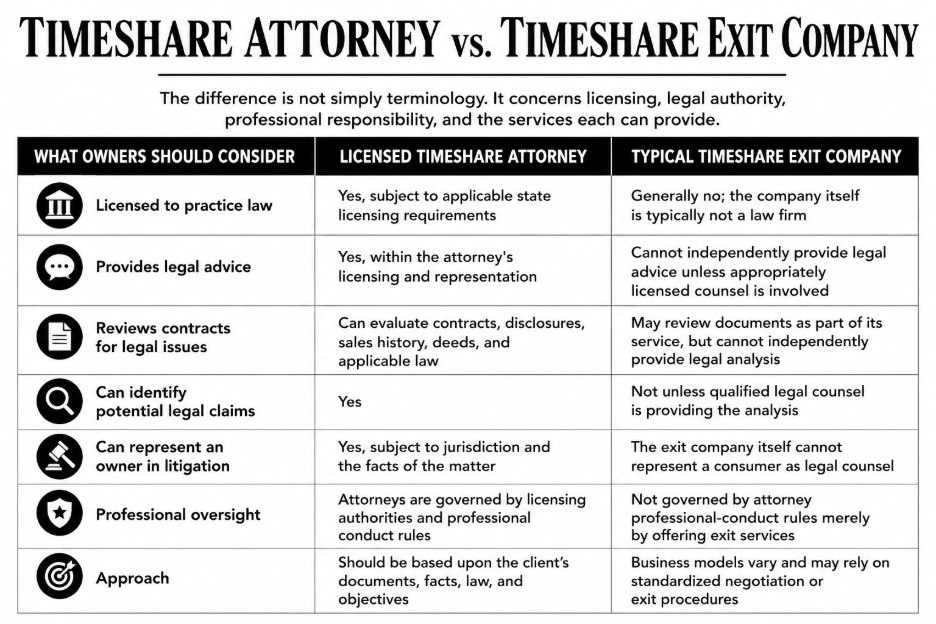
An exit company is not automatically fraudulent simply because it is not a law firm. But consumers should understand exactly what they are buying. If the service being advertised involves interpreting legal rights, challenging a contract, alleging statutory violations, or representing the consumer in a dispute, the qualifications of the person performing that work matter.
Be Cautious of a Second High-Pressure Sales Pitch
There is an uncomfortable irony in the timeshare exit marketplace. Some owners who believe they were pressured into buying a timeshare later encounter another high-pressure sales process when trying to escape it.
The product changes. The sales techniques can sound remarkably familiar.
“Act today.”
“This is your only opportunity.”
“Your fees are about to increase.”
“We guarantee we can get you out.”
“Don’t contact the resort.”
“Stop making payments immediately.”
Owners who already regret one pressured financial decision should be especially careful about making another.
You have every right to ask questions, review an agreement, verify an attorney’s license, research a company, and understand what will happen to your money before signing.
Verify the Attorney, Not Just the Company
A polished website is not a credential. If a business tells you attorneys will handle your matter, ask for their names.
Attorney licensing can generally be verified through the applicable state bar. Court admissions and published cases may provide additional information about an attorney’s professional history. Consumers should also determine whether the attorney actually represents them or merely has some business relationship with the company selling the service.
There is an important difference between hiring a law firm directly and paying a non-law-firm company that says it has attorneys somewhere in its network. You should know who represents you.
What Finn Law Group Looks at During a Timeshare Review
Finn Law Group approaches a timeshare matter as a legal problem first. Depending on the ownership and circumstances, the firm’s review may include the purchase agreement, deed, financing documents, points or club documents, subsequent upgrades, disclosures, maintenance-fee history, correspondence with the developer, and the circumstances surrounding the sales presentation.
The attorney can then consider how those facts interact with applicable contract law, timeshare statutes, consumer protection laws, property issues, and other potentially relevant legal principles. That does not mean every unhappy timeshare owner has a legal claim.
It means the answer should come from an informed review rather than from a sales script. That document-specific approach is central to Finn Law Group’s timeshare cancellation process.
Frequently Asked Questions
How do I know whether a timeshare cancellation attorney is legitimate?
Start by verifying the attorney through the appropriate state bar. Confirm that you are dealing with an actual law firm, identify the lawyer responsible for the representation, and read the engagement agreement carefully. You can also ask about relevant timeshare experience, litigation history, and the firm’s approach to cases like yours.
Should a timeshare attorney guarantee cancellation?
Be cautious about guarantees of a particular legal result. The outcome of a timeshare matter can depend on the contract, ownership structure, facts surrounding the sale, applicable law, developer response, and other circumstances. Guarantees are also unethical for attorneys to make or induce services with.
What should I bring to a timeshare consultation?
Start with your purchase agreement and deed, if you have one. Financing documents, upgrade agreements, points or membership materials, maintenance-fee statements, correspondence, and notes about what happened during the sales presentation may also be useful.
Can a lawyer help with both deeded timeshares and points programs?
Yes, although the analysis may differ. Deeded ownership can involve property and title issues, while points programs may involve memberships, trusts, contractual rights, or combinations of several ownership structures.
What happens if the developer refuses to cancel my timeshare?
A refusal does not automatically establish that the owner has a legal claim, nor does it necessarily end the analysis. An attorney can review the contract and facts to determine whether negotiation, contractual remedies, statutory claims, litigation, or other options may be appropriate.
Is hiring a timeshare attorney always better than using a developer surrender program?
Not necessarily. Some owners may qualify for legitimate developer-run surrender or deed-back programs that provide an appropriate resolution. The important issue is understanding the terms of the program and whether accepting it properly resolves the owner’s obligations.
How long does timeshare cancellation take?
There is no universal timeline. The ownership structure, developer, financing, facts, legal issues, and whether litigation is necessary can all affect how long a matter takes. Be cautious of anyone promising a precise completion date without first understanding the case.
Additional questions are addressed on Finn Law Group’s timeshare attorney FAQs.
Choosing the Right Timeshare Attorney Is About More Than Getting Out
For many owners, the immediate goal is understandable: I want out of my timeshare.
A lawyer’s responsibility is broader. The attorney should understand what the client owns, evaluate the contract and sales history, identify the law that applies, explain potential risks and remedies, and recommend a strategy supported by the facts.
Sometimes the appropriate path may be straightforward. Sometimes it is not. Either way, consumers deserve something more reliable than another sales promise.
They deserve an informed legal assessment.
If you are considering timeshare cancellation and want to understand what your documents and circumstances may mean, call 727-214-0700 or schedule a free consultation with Finn Law Group.
About Finn Law Group
Finn Law Group is a St. Petersburg, Florida-based law firm focused on timeshare law and consumer protection. Founded by attorney Michael D. Finn, the firm represents timeshare owners in matters involving vacation ownership contracts, sales practices, cancellation, developer disputes, and related consumer issues.
The firm’s approach begins with individual ownership rather than a standardized exit formula. Attorneys review the relevant contracts, ownership history, sales circumstances, and applicable law before evaluating potential options. Finn Law Group’s timeshare practice includes negotiation and litigation experience involving the timeshare industry.
Disclosure
This article is provided for general informational and educational purposes only and does not constitute legal advice. The phrase “best timeshare cancellation attorney” is used to discuss factors consumers may consider when evaluating legal representation and is not a claim or guarantee that Finn Law Group is the “best” law firm or attorney for any particular matter. Attorney qualifications, licensing, available remedies, and results depend on individual facts and applicable law. Past results do not guarantee future outcomes. Consult a licensed attorney regarding your specific circumstances.
| Not Sure How to Evaluate Your Timeshare Options? Every timeshare situation is different, and figuring out whether legal representation makes sense for yours starts with an honest conversation. You can schedule a free consultation with our team to discuss your ownership and the options that may apply. Call 727-214-0700 |